Childe Harold of Dysna
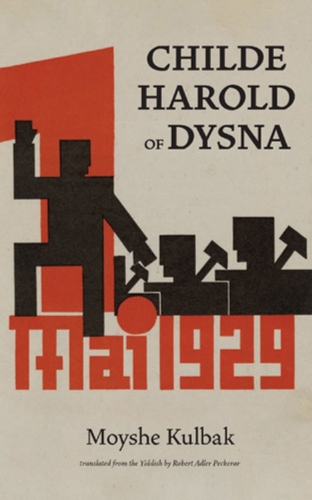
Childe Harold of Dysna
paperback
Published:
6 October, 2021

Popular Books by Moyshe Kulbak
View All Books by Moyshe Kulbak

Description
A masterpiece from one of Yiddish literature's true virtuosi, Moyshe Kulbak's satiric poem from 1933, Childe Harold of Dysna, appears here for the first time in a complete English translation.
At once an exuberant celebration of Yiddish language and a searing indictment of capitalist excess, Kulbak's long poem follows the journey of its protagonist from small town Eastern Europe to the metropolis of Weimar Berlin. Drawing on his own experiences in Berlin in the early 1920s, Kulbak offers us a fresh perspective on life in interwar Berlin, and does so in one of the truly great pyrotechnic displays in Yiddish poetry.
Robert Adler Peckerar's stunning translation conveys simultaneously Kulbak's verbal brilliance and his searing critique. This beautiful volume includes an introduction by Boris Dralyuk, the executive editor of the Los Angeles Review of Books, and stunning illustrations by Beynish.
More Details
| Type | Book |
|---|---|
| ISBN13 | 9781734193602 |
| ISBN10 | 1734193603 |
| Number Of Pages | 94 |
| Item Weight | 114 g |
| Product Dimensions | 128 x 204 x 8 mm |
| Publisher / Reseller | The Naydus Press |
| Format | paperback |
Author's Bio
The Yiddish language writer Moyshe Kulbak was born in 1896 in Smarhon (present-day Belarus, then in the Russian Empire) to a Jewish family, and later lived in Kovno (present-day Kaunas, Lithuania). After the Soviet Revolution he moved to Vilna (today Vilnius, Lithuania), and then in 1920 to Berlin. In 1923 he came back to Vilna, which after the war had become part of newly independent Poland, and was a centre of Yiddish literary culture. By 1928 he had become disappointed with the literary atmosphere in Poland, and moved to Minsk (by then capital of Soviet Belarus). In 1937 Kulbak was arrested during a wave of Stalinist purges, accused of espionage, and was executed a month later together with many other Belarusian writers and intellectuals. In 1956, after Stalin's death, he was officially rehabilitated by the Soviet authorities.
Moyshe Kulbak wrote poems, fantastical or mystical novels, and, after moving to the Soviet Union, what have been described as 'Soviet satires'.