Handbook of Developmental Systems Theory and Methodology
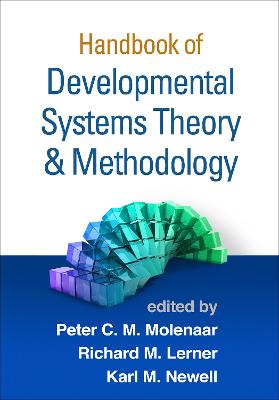
Handbook of Developmental Systems Theory and Methodology
hardback
Published:
5 March, 2014

Popular Books by Peter C. M. Molenaar
View All Books by Peter C. M. Molenaar
Description
Developmental systems theory provides powerful tools for predicting complex, dynamic interactions among biological and environmental processes in human behavior and health. This groundbreaking handbook provides a roadmap for integrating key concepts of developmental systems theory (such as self-organization, reciprocal dynamic interaction, and probabilistic epigenesis) and simulation models (connectionist and agent-based models) with advanced dynamic modeling approaches for testing these theories and models. Internationally renowned developmental science scholars present innovations in research design, measurement, and analysis that offer new means of generating evidence-based decisions to optimize the course of health and positive functioning across the life span. Topics include epigenetic development and evolution; the relationship between neural systems growth and psychological development; the role of family environments in shaping children's cognitive skills and associated adult outcomes, and more.
More Details
| Type | Book |
|---|---|
| ISBN13 | 9781609185091 |
| ISBN10 | 1609185099 |
| Number Of Pages | 517 |
| Item Weight | 1094 g |
| Publisher / Reseller | Guilford Publications |
| Format | hardback |
Media Reviews
This handbook covers topics at the leading edge of the developmental sciences. If the study of development over the last century has taught us anything, it's that development is enormously complicated--and disentangling it requires methodological and analytic approaches that mirror its complexity. This volume will serve researchers and students of development for years to come.--John Colombo, PhD, Department of Psychology and Director, Life Span Institute, University of Kansas
This volume makes good on a promise of developmental systems theory that has long gone unfulfilled: real confluence of the many scientific streams that flow into the developmental analysis of behavior. All of the great dichotomies that once characterized nature and nurture--biological and quantitative genetics, individual differences and species-typical characteristics, experimental and nonexperimental approaches, the lab bench and purely virtual simulations of quantitative models--are allowed here to flourish side by side without intellectual rancor. The result is an enriching synthesis that provides a model for the next generation of developmental scientists.--Eric Turkheimer, PhD, Department of Psychology, University of Virginia
Development is complex and extends over the entire life course, but early developmental scholarship tended to focus on narrow constructs and restricted portions of the life span. In contrast, this volume offers integrative, relational approaches to human development, assembling cutting-edge work on dynamic systems theory. The contributors identify and solve methodological challenges posed by systems theory, illuminate how new methodologies are grounded in metatheoretical concepts, and illustrate how new methods may be applied to understand and optimize human development. This is an excellent resource for faculty, staff researchers, and doctoral students who wish to study development in all its complexity.--Lynn S. Liben, PhD, Distinguished Professor of Psychology, The Pennsylvania State University.
Developmental systems theory provides an integrative theoretical foundation for the future of developmental science in a postgenomic world. This handbook provides key lessons about relevant cutting-edge methods along with a multitude of examples of how these methods can be applied. It is an invaluable resource for established developmental systems researchers as well as those seeking to apply this approach to their own work.--Peter J. Marshall, PhD, Department of Psychology, Temple University
-
Author's Bio
Peter C. M. Molenaar, PhD, is Distinguished Professor of Human Development and Psychology at The Pennsylvania State University. His research focuses on the development, testing, and application of person-centered analysis techniques; psychophysiological research; and psychological process modeling. The recipient of the 2013 Sells Award for Distinguished Multivariate Research from the Society of Multivariate Experimental Psychology, Dr. Molenaar has also received the Pauline Schmitt Russell Distinguished Research Career Award from Penn State and the Aston-Gottesman Award from the University of Virginia.
Â
Richard M. Lerner, PhD, is the Bergstrom Chair in Applied Developmental Science and Director of the Institute for Applied Research in Youth Development at Tufts University. Dr. Lerner's research focuses on the relations between life-span human development and social change, and the relations between adolescents and their peers, families, schools, and communities. He is a Fellow of the American Association for the Advancement of Science, the American Psychological Association (APA), and the Association for Psychological Science, and is a recipient of the Urie Bronfenbrenner Award for Lifetime Contribution to Developmental Psychology in the Service of Science and Society from Division 7 of the APA.
Â
Karl M. Newell, PhD, is the Marie Underhill Noll Chair of Human Performance and Professor of Kinesiology and Biobehavioral Health at Penn State. His research focuses on the coordination, control, and skill of normal and abnormal human movement across the life span; developmental disabilities and motor skills; and the influence of drugs and exercise on movement control. Dr. Newell was named an Alliance Scholar by the American Alliance for Health, Physical Education, Recreation, and Dance, and is a recipient of the Distinguished Scholar Award from the North American Society for the Psychology of Sport and Physical Activity.
Â