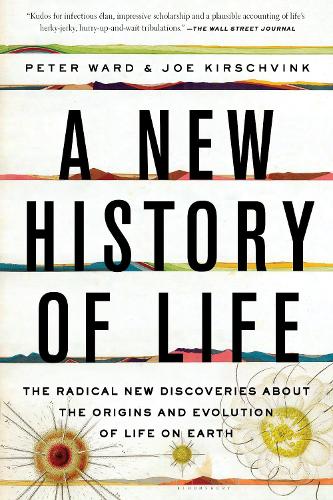
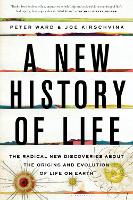
A New History of Life :The Radical New Discoveries about the Origins and Evolution of Life on Earth
A New History of Life :The Radical New Discoveries about the Origins and Evolution of Life on Earth
paperback | English
Published:
6 October, 2016

Popular Books by Peter Ward
View All Books by Peter Ward



Description
The history of life on Earth is, in some form or another, known to us all--or so we think. A New History of Life offers a provocative new account, based on the latest scientific research, of how life on our planet evolved--the first major new synthesis for general readers in two decades.
Charles Darwin’s theories, first published more than 150 years ago, still set the paradigm of how we understand the evolution of life--but scientific advances of recent decades have radically altered that. Now two pioneering scientists draw on their years of experience in paleontology, biology, chemistry, and astrobiology to deliver an eye-opening narrative using a generation’s worth of insights culled from new research.
Writing with zest, humor, and clarity, Ward and Kirschvink show that many of our long-held beliefs about the history of life are wrong. Three central themes emerge. First, Ward and Kirschvink argue that catastrophe shaped life’s history more than all other forces combined--from notorious events like the sudden extinction of dinosaurs to the recently discovered "Snowball Earth" and the "Great Oxygenation Event." Second, life consists of carbon, but oxygen, carbon dioxide, and hydrogen sulfide determined how it evolved. Third, ever since Darwin we have thought of evolution in terms of species. Yet it is the evolution of ecosystems--from deep-ocean vents to rainforests--that has formed the living world as we know it. Ward and Kirschvink tell a story of life on Earth that is at once fabulous and familiar. And in a provocative coda, they assemble discoveries from the latest cutting-edge research to imagine how the history of life might unfold deep into the future.
More Details
| Type | Book |
|---|---|
| ISBN13 | 9781608199105 |
| ISBN10 | 160819910X |
| Number Of Pages | 400 |
| Item Weight | 360 g |
| Product Dimensions | 140 x 210 x 28 mm |
| Publisher / Reseller | Bloomsbury Publishing Plc |
| Format | paperback |
Media Reviews
A NEW HISTORY OF LIFE deserves kudos for infectious élan, impressive scholarship and a plausible accounting of life’s herky-jerky, hurry-up-and-wait tribulations. * Wall Street Journal *
If you want to open your mind to the depths of modern thinking, then A NEW HISTORY OF LIFE is for you. Read it! * San Francisco Book Review *
A NEW HISTORY OF LIFE makes for an exciting and comprehensive read, enthralling to science nerds and lay readers who are curious about the rich natural history of planet Earth. * Nature World News *
The authors, both scientists, propose several different ways of looking at the history of life on earth, including the role that catastrophes played in shaping the development of living things. * Seattle Times *
Author's Bio
Peter Ward is a Professor of Biology and Professor of Earth and Space Sciences at the University of Washington. He has numerous seventeen books, among them the prizewinning Rare Earth: Why Complex Life Is Uncommon in the Universe, with Donald Brownlee, and his writing has earned varied honors, earning multiple nominations for awards ranging from the Keck Science Writing Award to the Los Angeles Times Book Award. He has been a main speaker at TED and has received the Jim Shea Award for popular science writing, joining recipients such as Stephen Jay Gould and John McPhee.
Joe Kirschvink is the Nico and Marilyn Van Wingen Professor of Geobiology at the California Institute of Technology, as well as a Fellow of the American Society for the Advancement of Science, the American Geophysical Union, and the American Academy of Arts and Sciences. His pioneering work in earth science includes formulating and naming the "Snowball Earth" hypothesis. Asteroid 27711 is named after him.