Black Bodies, White Gazes :The Continuing Significance of Race in America
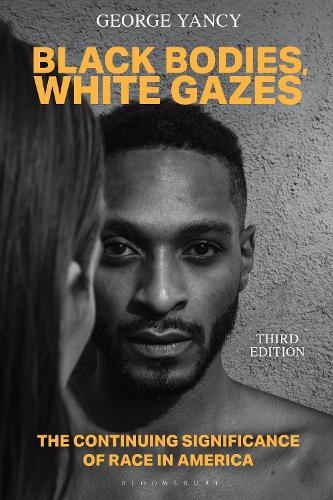
Black Bodies, White Gazes :The Continuing Significance of Race in America
paperback
Published:
18 September, 2025

Popular Books by George Yancy
View All Books by George Yancy
Description
George Yancy’s third edition of Black Bodies, White Gazes applies a clear and dynamic phenomenological framework of race to the history and most recent headlines in social justice and race relations. Including coverage of police murders and brutality against Black Americans and the rise of white nationalism, this is a timeless introduction to the philosophy of race.
The third edition features new chapter introductions and discussion questions from philosopher Taine Duncan; a new chapter giving critical phenomenological attention to contemporary anti-Black violence against individuals such as George Floyd, Ahmaud Arbery, Sonya Massey, and Kayla Moore; and a new coda featuring the author's interview with photographer Daniel C. Blight.
More Details
| Type | Book |
|---|---|
| ISBN13 | 9781538169834 |
| ISBN10 | 1538169835 |
| Number Of Pages | 400 |
| Item Weight | 660 g |
| Product Dimensions | 152 x 228 x 28 mm |
| Publisher / Reseller | Bloomsbury Publishing Plc |
| Format | paperback |
| Edition | 3rd edition |
Media Reviews
This book was a classic philosophical text since its initial publication—not simply because of its brilliance, but also because it sought to do something. This updated third edition only raises those stakes, reminding us why critical reflection, perhaps now more than ever, remains necessary; for in this text George Yancy listens to the dead, hears their blood crying out from the ground, refuses to abstract away from the concrete effects of the violent and vicious gaze of white supremacist antiblackness. This work is a powerful and painful expression of a prophetic cry for justice. If we listen, we will be changed. Or at least I was. -- Biko Mandela Gray, Syracuse University, USA
This new edition of George Yancy’s Black Bodies, White Gazes interrogates both the possibilities and the limits of a critical phenomenology of anti-Blackness in a world that continues to be structured by white supremacy. The addition of discussion questions to each chapter helps to move this conversation off the page, into the classroom and beyond, challenging readers to confront the way racist norms shape their own lived experience. If we have any hope of un-suturing ourselves from death-dealing anti-Blackness, it is through conversations such as these. -- Lisa Guenther, Queen's University, Canada
This is an essential book in so many ways—in the literature exploring anti-Black racism; the field of critical phenomenology; our attempts to understand Trumpian America; and to explore, perhaps challenge, our own personal experiences, wherever we are situated relative to the racial divide. Yancy's voice is clear, powerful, passionate, and uncompromising. He abandons the customary philosophical “view from nowhere” to write from very definite somewhere—elevators, conferences, street corners, as experienced by Black bodies subject to white gazes. He shares personal encounters; in-depth historical scholarship; first-person accounts; disturbing contemporary events. The book's power and arguments are cumulative as Yancy explores the history and phenomenology of racism and resistance. While rigorous in its philosophical analysis, Yancy's use of stories makes the book ever accessible to the lay reader or undergraduate. This third edition is usefully supplemented by contemporary examples and pedagogical aids. He takes philosophy out of the ivy tower (or should we say ivory-white tower?) and into the community where it is most needed—just as Socrates taught in the marketplace. While not made to drink hemlock, Yancy has had to pay a price in received hatred for his unflinching honesty. His own emotions—anger, sadness, pain—are undisguised, a rarity in the philosophical literature, and ultimately rooted in compassion for the very many who suffer in a racist regime -- Drew Leder, Loyola University Maryland, USA
Black Bodies, White Gazes is a seminal work in the philosophical study of race and racism and an important early contribution to what today is known as the field of critical phenomenology. Yancy's examination of the elevator effect remains one of the most powerful and sustained analyses of anti-Black racism in its relentlessly quotidian, but by no means benign, reality. With a keen eye for the embodied, affective, and existential demands of white supremacy, Yancy delivers an unflinching analysis of anti-Black racism and the systems, structures, imaginaries, practices, and people that sustain it. This is a book one should read and read again. -- Helen Ngo, Deakin University, Australia
George Yancy offers readers criticism that is philosophical in thought and intent, while remaining clear. It is work that is life-enhancing. Given the rise in racist terrorism and white supremacy globally, we are more in need than ever of work that shows us how our society places democracy at risk by upholding and maintaining systems of domination. Yancy's book highlights the issues and offers strategies for change. (previous edition praise) -- bell hooks
George Yancy’s work shows what engaged philosophy can be, taking on the complex and embodied processes of racialization to show that how we think and how we act is informed by the living legacies of racism. Yancy demonstrates what an ethically committed philosophy can be, asking its readers to examine their racial formations, whether to discover long-standing forms of racist subjugation or to examine the permutations of white complicity in anti-Black racism. His theory of the “white gaze” supplements and complicates the historical “male gaze” of feminist theory. Drawing from anti-racist writings, including the capacious work of women of color feminism, Yancy gives us a new way to think of philosophy as living, ethical, and engaged, demonstrating the violent toll on black bodies that accepted racism takes. This is critical thought that is rooted in the situation it seeks to clarify and transform. This is courageous and necessary work for our times, opposing at every instance the violence from which we too often look away. (previous edition praise) -- Judith Butler, Maxine Elliot Professor of Comparative Literature and Critical Theory, University of California, Berkeley, USA
Author's Bio
George D. Yancy is the Samuel Candler Dobbs professor of philosophy at Emory University and a Montgomery Fellow at Dartmouth College. He is the author, editor, and coeditor of over 20 books and known for his national and international influential essays and interviews at the New York Times, "The Stone."