The Secret Lives of Planets :A User's Guide to the Solar System – BBC Sky At Night's Best Astronomy and Space Books of 2019
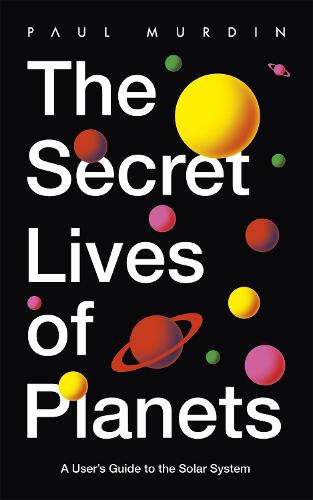
The Secret Lives of Planets :A User's Guide to the Solar System – BBC Sky At Night's Best Astronomy and Space Books of 2019
paperback
Published:
9 July, 2020

Popular Books by Paul Murdin
View All Books by Paul Murdin
Description
Nature
'A wonderfully clear and readable book . . . Gives a splendid overview of our Sun's planetary system, including its history and exploration'
Dame Jocelyn Bell Burnell
*
We have the impression that the solar system is perfectly regular like a clock, or a planetarium instrument. On a short timescale it is. But, seen in a longer perspective, the planets, and their satellites, have exciting lives, full of events - for example, did you know that Saturn's moon, Titan, boasts lakes which contain liquid methane surrounded by soaring hills and valleys, exactly as the earth did before life evolved on our fragile planet? Or that Mercury is the shyest planet? Or, that Mars' biggest volcano is 100 times the size of Earth's, or that its biggest canyon is 10 times the depth of the Grand Canyon, or that it wasn't always red, but blue?
The culmination of a lifetime of astronomy and wonder, Paul Murdin's enchanting new book reveals everything you ever wanted to know about the planets, their satellites, and our place in the solar system.
More Details
| Type | Book |
|---|---|
| ISBN13 | 9781529319408 |
| ISBN10 | 1529319404 |
| Number Of Pages | 288 |
| Item Weight | 208 g |
| Product Dimensions | 128 x 196 x 22 mm |
| Publisher / Reseller | Hodder & Stoughton |
| Format | paperback |
GoodReads Reviews
Author's Bio
Paul Murdin has worked as an astronomer in the USA, Australia, England, Scotland and Spain. Since 1963, he has been a research scientist (studying supernovae, black holes and neutron stars), an observatory administrator and a science policy maker for the government and the Royal Astronomical Society in the UK. He has travelled to universities and science centres in capital cities, to mountain-top observatories and to remote launch-pads. He works emeritus at the Institute of Astronomy in the University of Cambridge, England. He has had a secondary career as a broadcaster and commentator for the BBC and CNN, and is a talented lecturer and writer on astronomy. He is identified as the co-discoverer of the first stellar black hole found in our Galaxy, Cygnus X-1. He has been honoured by the Queen with an OBE for his work in international astronomy and for helping make astronomy accessible to everyone.