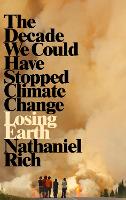
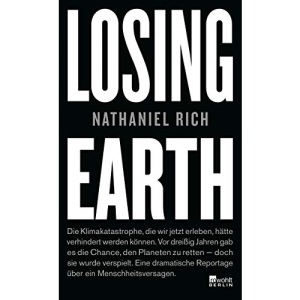
Losing Earth :The Decade We Could Have Stopped Climate Change
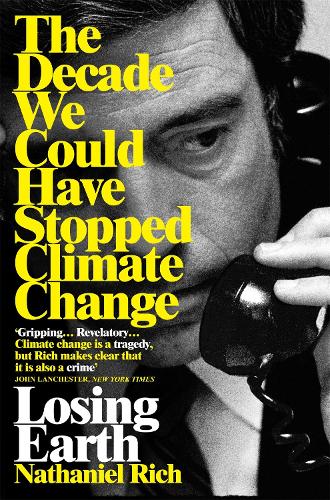
Losing Earth :The Decade We Could Have Stopped Climate Change
paperback
Published:
5 March, 2020

Popular Books by Nathaniel Rich
View All Books by Nathaniel Rich

Description
‘Nathaniel Rich’s account starts in Washington in the 1990s and tells the story of how climate change could have been stopped back then, if only the powerful had acted. But they didn’t want to.’ – Observer
By 1979, we knew all that we know now about the science of climate change – what was happening, why it was happening, and how to stop it. Over the next ten years, we had the very real opportunity to stop it. Obviously, we failed. Nathaniel Rich tells the essential story of why and how, thanks to the actions of politicians and businessmen, that failure came about. It is crucial to an understanding of where we are today.
‘The excellent and appalling Losing Earth by Nathaniel Rich describes how close we came in the 70s to dealing with the causes of global warming and how US big business and Reaganite politicians in the 80s ensured it didn’t happen. Read it.’ – John Simpson
‘An eloquent science history, and an urgent eleventh-hour call to save what can be saved.’ – Nature
‘To change the future, we must first understand our past, and Losing Earth is a crucial part of that when it comes to the environmental battles we’re facing.’– Stylist
More Details
| Type | Book |
|---|---|
| ISBN13 | 9781529015843 |
| ISBN10 | 1529015847 |
| Number Of Pages | 256 |
| Item Weight | 166 g |
| Product Dimensions | 130 x 198 x 16 mm |
| Publisher / Reseller | Pan Macmillan |
| Format | paperback |
Media Reviews
[Rich's] gripping, depressing, revelatory book makes it clear that not only is climate change a tragedy,
but that it is also a crime — a thing that bad people knowingly made worse, for their personal gain.
The excellent and appalling Losing Earth by Nathaniel Rich describes how close we came in the 70s to dealing with the causes of global warming and how US big business & Reaganite politicians in the 80s ensured it didn’t happen. Read it. -- John Simpson (on Twitter)
Rich brilliantly relates the story of how, in 1979 . . . policymakers [were alerted] to the existential threat, only to see climate treaties fail in a welter of ‘profit over planet’ a decade later. An eloquent science history, and an urgent eleventh-hour call to save what can be saved. * Nature *
To change the future, we must first understand our past, and Losing Earth is a crucial part of that when it comes to the environmental battles we’re facing. * Stylist *
Others have documented where we are, and speculated about where we might be headed, but the story of how we got here is perhaps the most important one to be told, because it is both a cautionary tale and an unfinished one. -- Jonathan Safran Foer
Nathaniel Rich recounts how a crucial decade was squandered. Losing Earth is an important contribution to the record of our heedless age. -- Elizabeth Kolbert
[Losing Earth] chronicles the failure of our scientific and political leaders to act to halt the climate apocalypse when they appeared on the verge of doing so, and casts the triumph of denial as the defining moral crisis for humankind. -- Philip Gourevitch
Rich demonstrates exquisitely how shallow debate of a deep problem – the planetary scale and civilizational consequences of climate change – exacerbates the problem. -- Stewart Brand
A gripping piece of history . . . Rich's writing is compelling . . . Like a Greek tragedy, Losing Earth shows how close we came to making the right choices. * National Public Radio *
Nathaniel Rich’s account starts in Washington in the 1990s and tells the story of how climate change could have been stopped back then, if only the powerful had acted. But they didn’t want to. * Observer *
GoodReads Reviews
Author's Bio
Nathaniel Rich is the author of two previous novels, Odds Against Tomorrow and The Mayor’s Tongue, and a work of nonfiction, Losing Earth: A Recent History. His short fiction has appeared in McSweeney’s, The Virginia Quarterly Review, and VICE, and he is a writer at large for The New York Times Magazine. He lives in New Orleans.