Governance by Numbers :The Making of a Legal Model of Allegiance - Hart Studies in Comparative Public Law
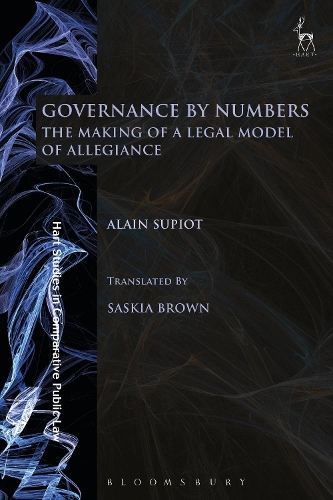
Governance by Numbers :The Making of a Legal Model of Allegiance - Hart Studies in Comparative Public Law
paperback
Published:
19 March, 2020

Popular Books by Professor Alain Supiot
View All Books by Professor Alain Supiot

Description
The West's cherished dream of social harmony by numbers is today disrupting all our familiar legal frameworks - the state, democracy and law itself. Its scientistic vision shaped both Taylorism and Soviet Planning, and today, with 'globalisation', it is flourishing in the form of governance by numbers. Shunning the goal of governing by just laws, and empowered by the information and communication technologies, governance champions a new normative ideal of attaining measurable objectives. Programmes supplant legislation, and governance displaces government.
However, management by objectives revives forms of law typical of economic vassalage. When a person is no longer protected by a law applying equally to all, the only solution is to pledge allegiance to someone stronger than oneself. Rule by law had already secured the principle of impersonal power, but in taking this principle to extremes, governance by numbers has paradoxically spawned a world ruled by ties of allegiance.
More Details
| Type | Book |
|---|---|
| ISBN13 | 9781509936977 |
| ISBN10 | 1509936971 |
| Number Of Pages | 336 |
| Item Weight | 480 g |
| Product Dimensions | 154 x 232 x 18 mm |
| Publisher / Reseller | Bloomsbury Publishing PLC |
| Format | paperback |
Media Reviews
[T]he volume is an impressive tour de force which engages many disciplines in order to explain the main tenets of the model of governance by numbers. Its contribution to constitutional studies is remarkable as it links the rise of governance to a pervasive model of organization of many social and legal institutions. -- Marco Goldoni, Glasgow University * International Journal of Constitutional Law *
[A] highly readable if intellectually challenging effort to pin down the effects on law of the move to 'governance through numbers'. -- David Nelken, Dickson Poon School of Law, King's College London * Journal of Law and Society *
Author's Bio
Alain Supiot is Professor at the Collège de France and Corresponding Member of the British Academy.