Conventional Wisdom, Parties, and Broken Barriers in the 2016 Election
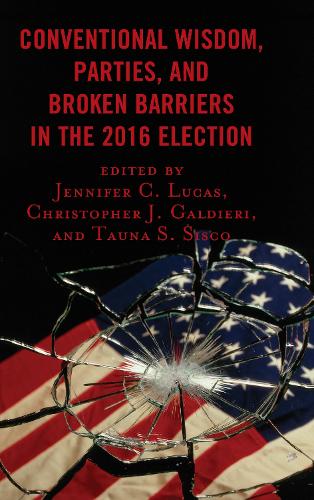
Conventional Wisdom, Parties, and Broken Barriers in the 2016 Election
paperback
Published:
6 February, 2020

Popular Books by Julia R. Azari
View All Books by Julia R. Azari
Description
The 2016 presidential election was unconventional in many ways. The election of President Donald Trump caught many by surprise, with a true outsider — a candidate with no previous governmental experience and mixed support from his own party — won the election by winning in traditionally Democratic states with coattails that extended to Republican Senate candidates and resulted in unified Republican government for the first time since 2008. This result broke with the pre-election conventional wisdom, which expected Hillary Clinton to win the presidency and a closer Senate divide. This surprising result led many political scientists to question whether 2016 truly marked a major turning point in American elections as portrayed in the media — a break from the conventional wisdom – or whether it was really the exception that proved the rule.
In this volume, political scientists examine previous theories and trends in light of the 2016 election to determine the extent to which 2016 was a break from previous theories. While in some areas it seems as though 2016 was really just what would have been predicted, in others, this election and the new president pose significant challenges to mainstream theories in political science. In particular, prominent political scientists examine whether voter trends, with particular focus on groups by gender, age, geography, and ethnicity, and election issues, especially the role of the Supreme Court, followed or bucked recent trends. Several political scientists examine the unconventional nomination process and whether this signals a new era for political parties. The role of conspiracy theories and voter confidence in the administration of elections are also discussed. Finally, contributors also examine the indirect effect the presidential candidates, especially Trump, played in congressional election rhetoric.
More Details
| Type | Book |
|---|---|
| ISBN13 | 9781498566636 |
| ISBN10 | 1498566634 |
| Number Of Pages | 272 |
| Item Weight | 417 g |
| Product Dimensions | 152 x 223 x 20 mm |
| Publisher / Reseller | Bloomsbury Publishing Plc |
| Format | paperback |
Media Reviews
The election of 2016 broke many conventions about American politics and left many questions about how and why it turned out as it did. This book is an early step in answering those questions. Conventional Wisdom comprises 12 chapters addressing aspects of the 2016 presidential election. Using accessible methodology, the authors offer detailed explanations about what happened. Though the work provides no definitive answer for those still scratching their heads and trying to explain the Trump phenomenon, it does include a great deal of insight that could lead to some larger explanation. If readers are looking for a concise volume that lays out an array of questions and plausible answers, this volume is just what they need.
Summing Up: Recommended. Upper-division undergraduates through faculty.
The 2016 contest produced more than the usual number of surprises while also advancing larger trends in partisan, electoral, ethnic, and gender politics. In this book, an expert team of scholars sifts through the evidence to tell us what changed and what didn’t —placing the events of 2016 in welcome theoretical and historical context while authoritatively addressing the many new questions that have emerged in the wake of such a historic election. -- David Hopkins, Boston College
The 2016 election cycle challenged much of the conventional wisdom in American politics. The role of political parties, endorsements, fundraising, gender norms, ideology, policy issues, party elites, and rank and file voters, all seemingly changed context during this contentious campaign. A great group of authors explore the impact that the Trump and Clinton campaigns had on the national congressional contests and whether 2016 will mark a major turning point in American elections or it was an exception that helped to prove the rule. These political scientists examine previous theories and trends in light of the 2016 election outcomes to determine the extent to which the unconventional campaign undermined or supported those theories. While in some areas it seems as though 2016 was really just what would have been predicted, in others, this election and the style of the new president pose significant challenges to mainstream theories in political science. How did Trump’s plain spoken, outsider political message effect down ballot races? Did past or present Clinton scandals influence voters? How did the Supreme Court vacancy impact Senate races? What role did gender norms and values play in voter’s decisions? This volume aims to answer the above questions and more, and put political science conventional wisdom to the test. -- Sean D. Foreman
Author's Bio
Tauna S. Sisco is associate professor of sociology at Saint Anselm College.
Jennifer C. Lucas is professor of politics at Saint Anselm College.
Christopher J. Galdieri is associate professor of politics at Saint Anselm College.