Aristocratic Souls in Democratic Times - Political Theory for Today
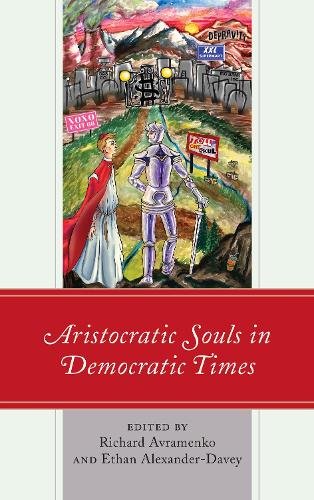
Aristocratic Souls in Democratic Times - Political Theory for Today
hardback
Published:
7 May, 2018

Popular Books by Richard Avramenko
View All Books by Richard Avramenko


Description
More Details
| Type | Book |
|---|---|
| ISBN13 | 9781498553261 |
| ISBN10 | 1498553265 |
| Number Of Pages | 350 |
| Item Weight | 712 g |
| Product Dimensions | 164 x 232 x 31 mm |
| Publisher / Reseller | Bloomsbury Publishing Plc |
| Format | hardback |
Media Reviews
We live in a time where the crisis of liberal democracy now manifests itself in the attraction of the “rule of the wise and the good”—whatever that means—as a salutary corrective to the seeming inability of liberal democratic politics to solve the world’s problems. Examples include the desire to have Keynsians guide the economy because the market cannot correct itself; the progressive view that bureaucratic “rule by experts” can “nudge” citizens into making better choices for themselves and society; and the view that the Chinese authoritarian model is better equipped than liberal democracy to handle climate issues. Strangely, the attraction of inegalitarian politics can even be seen in recent academic defences of equality that can do no better than argue that equality is good because good people believe in it. Thus even the good of equality is seen to depend upon inequality. The crisis of liberal democracy seems to consist in a demand for the best (aristo) to lead but democratic souls are ill-equipped to discern what counts as best. Proudly standing on what demagogues call the “wrong side of history,” the contributors to Aristocratic Souls in Democratic Times clarify the profound differences between democracy and aristocracy and their respective moral codes, and thereby provide guidance during this time of liberal democratic confusion and perplexity. -- John von Heyking, University of Lethbridge
Democracy keeps us prejudiced against the possibility that aristocratic constitutions, in cities or souls, are worthy of esteem. This volume addresses that aristocratic deficit, with distinction. You’ll be reminded what it’s like to be oriented toward the noble and the beautiful, more concerned with souls than bodies, character than feelings, action than satisfactions. In theory, liberal democracy allows more people than ever to enjoy the freedoms and privileges of aristocrats; in practice, it seems determined to deprive everybody of them. At a time when the directions of democracy seem increasingly despotic, this volume is indispensable. -- Travis D. Smith, author of Superhero Ethics, associate professor of political science, Concordia University
Originally, political science was a practical science. This series, Political Theory for Today, builds on that understanding by examining perennially relevant problems and questions. This volume deals with aristocratic souls, the best souls, as distinct both from mere nobility of blood and from ordinary or equal souls (and bodies). The context is provided by democratic times and democratic regimes, our times, our regimes. The authors discuss the great texts from the Roman Empire to recent America with a view to understanding the place of aristocratic virtue in modern democracy (if there is one). Implicitly the authors raise the question as to whether there is any other kind of virtue. Even the most vulgar egalitarian will benefit by considering what he or she obviously lacks. This book will provide a splendid antidote to several strains of political correctness now besetting our universities. -- Barry Cooper, University of Calgary
Traditionalists often eschew academia, but the editors of this volume have somehow raised a small regiment to launch a hussar charge against today's pieties, offering all kinds of insights into now almost-forgotten episodes, and almost-unimaginable ideas. * Chronicles: A Magazine of American Culture *
Aristocratic Souls in Democratic Times is a welcome and needed contribution to the political theory literature on aristocratic political thought, and on the whole a courageous effort to be true to the intentions of its subjects. It does not shy away from the unfashionable ideas of those whom C. S. Lewis might have called men with chests, or even modes of political thought that might today be considered fundamentally immoral. If there is indeed a crisis of liberalism afoot or at hand, considering the thoughtful critiques of preliberal and even antiliberal men may be a first step to diagnosing and prescribing our way out of the crisis. * Interpretation *
Author's Bio
Richard Avramenko is associate professor of political science and the chairman of the Integrated Liberal Studies Program at the University of Wisconsin, Madison.
Ethan Alexander-Davey is assistant professor of political science at Campbell University.