The Novel of a Novel :Abridged Diary Entries from Moscow, 1935–1937
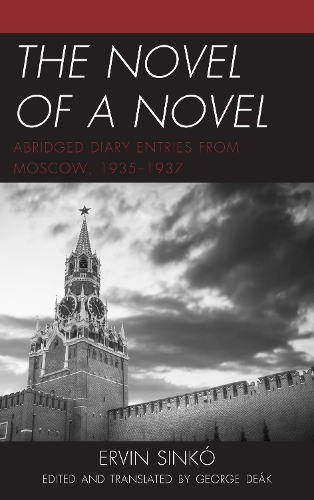
The Novel of a Novel :Abridged Diary Entries from Moscow, 1935–1937
hardback
Published:
20 March, 2018

Description
More Details
| Type | Book |
|---|---|
| ISBN13 | 9781498546362 |
| ISBN10 | 1498546366 |
| Number Of Pages | 380 |
| Item Weight | 739 g |
| Product Dimensions | 158 x 238 x 34 mm |
| Publisher / Reseller | Bloomsbury Publishing Plc |
| Format | hardback |
Media Reviews
An astonishing book. It is astonishing that Ervin Sinkó kept such a witheringly sincere diary during the purges in Moscow, and astonishing that he was able to preserve it. His endless, forbidding, and frustrating encounters with Soviet bureaucrats slowly erode his faith in Soviet rule and stoke his disillusionment, just as arrests, trials, and a corrosive fear enveloped his circle of friends. Sinkó's meetings with several iconic figures, among them Isaac Babel and Mikhail Koltsov, the visiting Romain Rolland, along with glimpses of Sergei Eisenstein and Solomon Mikhoels, are a unique source of insight and information about life in Stalin's ruthless kingdom. Faced with the rising threat of fascism, Sinkó wanted to hold onto his faith in the Soviet Union but he was too honest with himself to disregard the reality that never stopped slapping him in the face. -- Joshua Rubenstein, Harvard University
Ervin Sinkó’s combination of diary and memoir is a riveting and insightful read about life in Moscow during the early years of Stalin's terror. Many of the prominent acquaintances he writes about became victims of the ‘chistka,’ or Soviet purge. The historian George Deák’s masterful abridged translation does justice to the original work, which is an important eyewitness contribution to the understanding of a crucial era. -- Peter Pastor, Montclair State University
A frank and sober witness testimony by a Western revolutionary writer written in the Soviet Union in 1935–37, in the days of growing repression and political purges. Ervin Sinkó’s contemporary diaries were written under unique circumstances, as the writer struggled in the Kafkaesque maze of the Soviet ‘cultural’ and literary labyrinth. Sinkó has put on record controversial public and private debates about the Moscow Trials amongst the major Western supporters of the Soviet Union—Romain Rolland, André Malraux, Jean-Richard Bloch, and others. His account of the fear-induced behaviors by the Soviet cultural elite—Maxim Gorky, Isaac Babel, Sergey Eisenstein, Mihail Koltsov, Sergey Tret’yakov, and the ‘cultural ‘ institutions leaders official Alexandr Arosev (VOKS) and Mikhail Apletin (Foreign Commission of the Soviet Writers’ Union)—is particularly striking. A new light is shed on the actions of the Western Comintern members Bela Kun, Alfred Kurella, and other foreign communists as the Comintern was heading towards a massive purge. -- Ludmila Stern, University of New South Wales
‘It is not easy to be a revolutionary in the country of the victorious revolution.’ Ervin Sinkó’s diary of the two years he spent in Stalin’s Moscow at the time of the show trials is a jewel, offering a very rare account of the dilemmas and contradictions faced by a Central European anti-fascist intellectual confronted by the realities of Soviet life and politics. Sinkó analyzes with great lucidity how the regime molds its citizens’ behavior and worms itself into their minds. A denizen of Moscow’s literary and cinematic world, he also gives the reader a vivid picture of the anxiety, compromise, and defiance involved in surviving as an artist and a human being. With a brilliant introduction by translator George Deák, this is an essential book on the utopian hopes invested in the Russian Revolution, and their disappointment. -- Brigitte Studer, University of Bern
. . . . Ervin Sinkó's The Novel of Novel a thought-provoking journey into the psyche of a man, who, through all his self-questioning struggles, provides us with an invaluable insight into the "how"s and "why"s of twentieth-century history. It is a novel that more people around the world should read, and George Deák’s fine English translation might help it accomplish this goal. * Hungarian Cultural Studies *
Author's Bio
Ervin Sinkó (1898–1967) was a Hungarian writer and intellectual.
George Deák received his PhD in history from Columbia University.