Living Off the Land in Space :Green Roads to the Cosmos
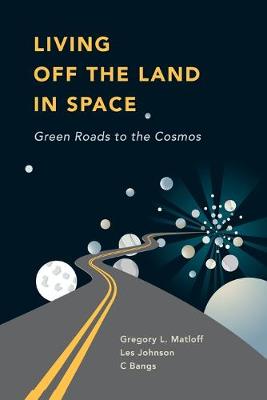
Living Off the Land in Space :Green Roads to the Cosmos
paperback
Published:
18 September, 2014

Popular Books by C Bangs
View All Books by C Bangs
Description
Human civilization has evolved to the point at which we can consider tapping space resources and expanding beyond Earth’s atmosphere. The Introduction surveys possible motivations for large-scale human emigration to space. Since our early ancestors began to move out of Africa, humans have constantly expanded their range. Today, the pattern of human settlement extends from pole to pole. Humans regularly visit the upper troposphere and ocean floor and technology has enabled a few to even reside above the atmosphere in space stations.
For the next few millennia at least (barring breakthroughs), the human frontier will include the solar system and the nearest stars. Will it better to settle the Moon, Mars, or a nearby asteroid and what environments can we expect to find in the vicinity of nearby stars are questions that need to be answered if mankind is to migrate into space.
More Details
| Type | Book |
|---|---|
| ISBN13 | 9781489988775 |
| ISBN10 | 1489988777 |
| Number Of Pages | 247 |
| Item Weight | 1000 g |
| Publisher / Reseller | Springer-Verlag New York Inc. |
| Format | paperback |
| Edition | 2007 ed. |
Media Reviews
From the reviews:
"The goal of the book is to provide a realistic view of what might be possible with technologies that are accessible in the near future. A wealth of references at the end of each chapter point the way to further resources. Living Off the Land in Space should satisfy anyone who wants to learn about space colonization and the propulsion methods that will make it happen." (Bernd Henschenmacher, www.centauri-dreams.org, September, 2007)
"This book is … about ways of powering spaceships to get to other worlds. … the book explores ways of accelerating spaceships using the environments encountered on the journey through space. … The book discusses other means of powering spacecraft, including gravity assists from planetary flybys, ion drives, solar sailing and electromagnetic tethers. … Overall the book is more a review of current or developing techniques … . I found it an enjoyable read and informative." (P L Dyson, Australian Physics, Vol. 45 (1), 2008)
"A sustainable long-term presence in space certainly requires the use of in-space resources with new technologies. This is the subject of the book Living off the Land in Space. Green Roads to the Cosmos. The word Green refers to the use of technologies lessening or eliminating any dependence on Earth, not because they have no impact on Earth’s environment. … I can recommend this book to everyone interested in the future of space exploration. The book is written by a pair of scientists … ." (Claude Semay, Physicalia, Vol. 30 (2), 2008)
Author's Bio
At present, Dr Matloff teaches physics and astronomy as an Assistant Professor at New York City Technical College, CUNY. He has pioneered the application of gossamer spacecraft to deep-space exploration and has served as a Faculty Fellow in summer 1999, 2000 and 2001 at NASA Marshall Spaceflight Center (MSFC), Huntsville AL. He has participated there on a design team planning interstellar missions propelled by solar sails unfurled Sunward of the Earth. He consults for NASA through Gray Research and Teledyne Brown, in Huntsville AL.
Les Johnson manages the Science Programs and Projects Office at NASA's Marshall Space Flight Center. In addition to his NASA credentials, Johnson also is an inventor. He holds three patents, including one received in 1989 for a laser-triggered, fiber-optic neutron detector. His most recent patent was awarded in July 2003 for an electrodynamic sail for propulsion. Johnson is also a two-time recipient of the NASA Exceptional Achievement Medal.
Ms Bangs’ work is in many permanent collections, including MSFC, the US Library of Congress, the Mint Museum and the Chrysler Museum.