Visualizing Fascism :The Twentieth-Century Rise of the Global Right
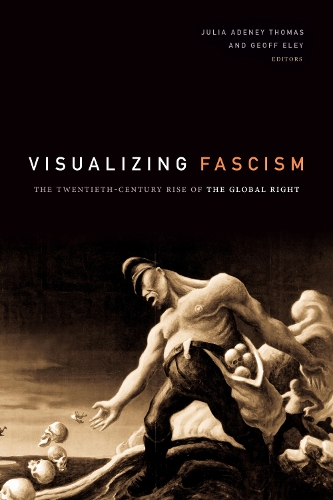
Visualizing Fascism :The Twentieth-Century Rise of the Global Right
paperback
Published:
13 March, 2020

Popular Books by Julia Adeney Thomas
View All Books by Julia Adeney Thomas





Description
Contributors. Nadya Bair, Paul D. Barclay, Ruth Ben-Ghiat, Maggie Clinton, Geoff Eley, Lutz Koepnick, Ethan Mark, Bertrand Metton, Lorena Rizzo, Julia Adeney Thomas, Claire Zimmerman
More Details
| Type | Book |
|---|---|
| ISBN13 | 9781478003762 |
| ISBN10 | 1478003766 |
| Number Of Pages | 336 |
| Item Weight | 522 g |
| Publisher / Reseller | Duke University Press |
| Format | paperback |
Media Reviews
“In a volume of instructive and newly timely essays, we learn about the key role played by the circulation of people and the visual culture they made in constructing fascism's global imaginary of interconnectedness. From the 1920s to the 1950s, fascist visuality in Asia and Europe brought the intimacies of everyday life and the realm of mass spectacle together in a variety of forms. Moving beyond the usual subjects of futurism and Leni Riefenstahl, the volume expands the visual repertoire of the period's politicized visual field as it reintroduces readers to its contested grounds.” - Vanessa R. Schwartz, Director, Visual Studies Research Institute, University of Southern California “Unlike so many works that relegate the phenomenon of fascism to a few moments in the past and to an isolated number of usual suspects, this wide-ranging volume focuses on the visual but goes way beyond it to demonstrate that fascism has come in varied but contiguous forms throughout the world-and perhaps as important, threatens to do so again in our time. An absolutely stunning and pathbreaking intervention by leading scholars of fascism and modernity.” - Takashi Fujitani, author of (Race for Empire: Koreans as Japanese and Japanese as Americans during WWII) "The book highlights the saliency of bridging the written and the visual and urges historians not to restrain from enriching their 'historians's craft' by listening to, reading and looking at the silence of images." - Elena Maria Rita Rizzi (European Review of History) "The volume has much to offer due to the geographical scope of its case studies.… Visualizing Fascism is a welcome addition to the literature, calling for an understanding of fascism as a transnational phenomenon typified by the fluid circulation of fascist ideology and imagery." - Mark Antliff (Journal of Visual Culture)
Author's Bio
Julia Adeney Thomas is Associate Professor of History at the University of Notre Dame and author of Reconfiguring Modernity: Concepts of Nature in Japanese Political Ideology.
Geoff Eley is Karl Pohrt Distinguished University Professor of Contemporary History at the University of Michigan and author of Nazism as Fascism: Violence, Ideology, and the Ground of Consent in Germany, 1930–1945.