The Conversational Enlightenment :The Reconception of Rhetoric in Eighteenth-Century Thought
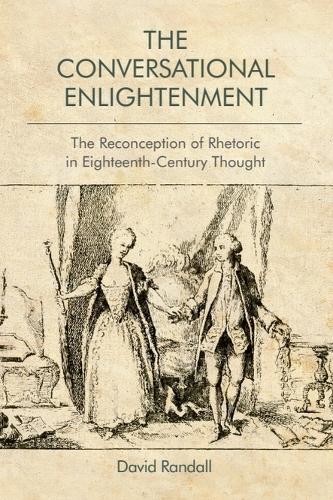
The Conversational Enlightenment :The Reconception of Rhetoric in Eighteenth-Century Thought
paperback
Published:
10 November, 2020

Popular Books by David Randall
View All Books by David Randall


Description
More Details
| Type | Book |
|---|---|
| ISBN13 | 9781474448673 |
| ISBN10 | 1474448674 |
| Number Of Pages | 296 |
| Item Weight | 460 g |
| Publisher / Reseller | Edinburgh University Press |
| Format | paperback |
Media Reviews
In this bold and wide-ranging investigation, Randall shows how the Western rhetorical tradition illuminates conversation and its impact on literature, philosophy and art in eighteenth-century Britain, France and America. What emerges is an account of the politics of conversation that reconfigures our understanding of the eighteenth-century communicative domain. * Lawrence E. Klein, University of Cambridge *
Conversation' is a notoriously difficult topic to tackle sensibly (about as hard as 'a history of tears,' says French scholar Marc Fumaroli) but David Randall has cracked it. Most originally, he identifies a 'conversational aesthetic' that might have begun in France but quickly extended right across Europe in the eighteenth century and invaded art, architecture, dance, music being conceived as a form of conversation among instruments). He shows how conversation was associated with liberty and that compared with rhetoric, conversation calmed the passions and in so doing helped to clarify the mind, eventually giving rise to the power of public opinion. Fascinating in its range of detail. * Peter Watson, Author of Ideas: A History from Fire to Freud and, forthcoming, The French Mind *
The sheer amount of material [this book covers] is at least half the appeal. Randall weaves a thick, elaborate, and mostly seamless tapestry from sometimes disparate threads. He prefers to let the texts speak for themselves, drawing his conclusions following lengthy quotations in English, French, and Italian. The other half of the [book's] appeal, then, is in Randall’s nimble analyses. For instance, he finds persuasive geographical, temporal, and conceptual continuities to demonstrate the significance of natural law jurisprudence’s emphasis on self-preservation, an emphasis that runs from Hugo Grotius, Thomas Hobbes, and Samuel Pufendorf through to the link between sociability, on theone hand, and behavior and manners, on the other. -- James Donathan Garner, University of Texas at Austin * Rhetorica *
Author's Bio
David Randall is Director of Research at the National Association of Scholars. His publications include Credibility in Elizabethan and Early Stuart Military News (2008) and English Military News Pamphlets, 1513-1637 (2011).