Eco-Cultural Networks and the British Empire :New Views on Environmental History
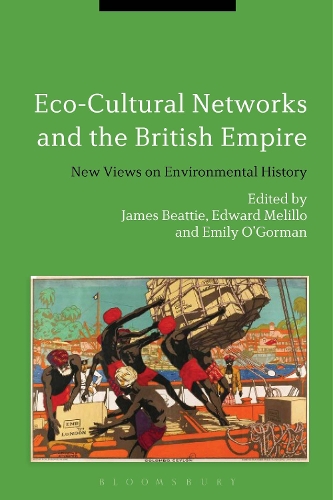
Eco-Cultural Networks and the British Empire :New Views on Environmental History
paperback
Published:
30 June, 2016

Description
19th-century British imperial expansion dramatically shaped today‘s globalised world. Imperialism encouraged mass migrations of people, shifting flora, fauna and commodities around the world and led to a series of radical environmental changes never before experienced in history. Eco-Cultural Networks and the British Empire explores how these networks shaped ecosystems, cultures and societies throughout the British Empire and how they were themselves transformed by local and regional conditions.
This multi-authored volume begins with a rigorous theoretical analysis of the categories of ‘empire’ and ‘imperialism’. Its chapters, written by leading scholars in the field, draw methodologically from recent studies in environmental history, post-colonial theory and the history of science. Together, these perspectives provide a comprehensive historical understanding of how the British Empire reshaped the globe during the 19th and 20th centuries. This book will be an important addition to the literature on British imperialism and global ecological change.
More Details
| Type | Book |
|---|---|
| ISBN13 | 9781474294393 |
| ISBN10 | 1474294391 |
| Number Of Pages | 344 |
| Item Weight | 481 g |
| Publisher / Reseller | Bloomsbury Publishing PLC |
| Format | paperback |
Media Reviews
This new collection of essays ... demonstrates the rewards of examining environments through the lens of empire, and vice versa. It also confirms the benefits of transcending the boundaries of particular colonies or metropole–colony relations. * English Historical Review *
The instant ‘global moment’ has a history. At our present time of global environmental thinking, it is timely to pay attention to the history of how ecological ideas travelled through imperial networks around the world in the past. These eminent historians together present an exciting theoretical framework and a wealth of nuanced stories about how imperialism shaped the natural world, and Nature responded. * Libby Robin, Professor of Environmental History, Australian National University and co-editor of The Future of Nature and Ecology and Empire *
This edited collection offers environmental historians and historians of empire an innovative framework through which to map and comprehend the complex interactions and dependencies between the peoples and places of the British Empire. * Australian Journal of Politics and History *
This volume is a significant contribution to the [field] ... [A]n unusually well-edited anthology and an excellent and engaging read. * Environmental History *
In sum, here we have a nice book: useful - the chapters all end with a bibliography that is succinct but relevant and up-to-date - offering avenues for reflection, case studies that are often exciting, and an innovative concept. * Revue d'histoire moderne et contemporaine (Bloomsbury translation) *
The sun never set on the British Empire, nor did environmental change ever cease. This volume shows how local forces and imperial networks joined to alter ecologies, economies, cultures, and societies from the 1840s to the 1940s everywhere from Canada to New Zealand to Ceylon to South Africa. With essays on everything from climate and commodities to birds and urban beasts -- and much else besides -- this book is a most welcome addition to the field now taking shape at the junction of environmental and imperial history. * John R. McNeill, Professor of History, Georgetown University, USA *
This diverse collection of essays from around the globe provides fascinating and stimulating perspectives on the reciprocal webs of empire. In linking diverse regions such as China, New Zealand, Australia and Canada, the authors combine their innovative research with clear writing. Their unravelling of complex transnational and trans-colonial eco-cultural networks deserves close attention from all who are interested in understanding more fully how the kaleidoscopic imperial exchange of commodities and environmental ideas shaped our world. * Jane Carruthers, Professor Emeritus of History, University of South Africa *
Author's Bio
James Beattie is Senior Lecturer at the University of Waikato, New Zealand. He is the author of Empire and Environmental Anxiety (2011) and a founding co-editor of the journal International Review of Environmental History.
Edward Melillo is Assistant Professor at Amherst College, USA. He teaches courses on global environmental history and is the author of Strangers on Familiar Soil.
Emily O'Gorman is an environmental and cultural historian in the Department of Environment and Geography at Macquarie University, Australia. She has published in a range of journals and is the author of Flood Country: An Environmental History of the Murray-Darling Basin (2012). She is an Associate Editor of the journal Environmental Humanities.