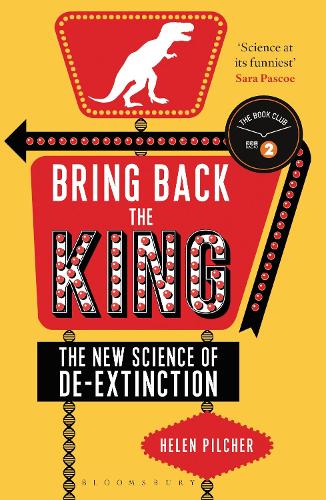
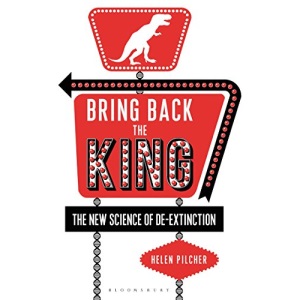
Bring Back the King :The New Science of De-extinction
Bring Back the King :The New Science of De-extinction
paperback
Published:
21 September, 2017

Popular Books by Helen Pilcher
View All Books by Helen Pilcher



Description
If you could bring back just one animal from the past, what would you choose?
It can be anyone or anything from history, from the King of the Dinosaurs, T. rex, to the King of Rock ‘n’ Roll, Elvis Presley, and beyond.
De-extinction – the ability to bring extinct species back to life – is fast becoming reality. Around the globe, scientists are trying to de-extinct all manner of animals, including the woolly mammoth, the passenger pigeon and a bizarre species of flatulent frog. But de-extinction is more than just bringing back the dead. It’s a science that can be used to save species, shape evolution and sculpt the future of life on our planet.
In Bring Back the King, scientist and comedy writer Helen Pilcher goes on a quest to identify the perfect de-extinction candidate. Along the way, she asks if Elvis could be recreated from the DNA inside a pickled wart, investigates whether it’s possible to raise a pet dodo, and considers the odds of a 21st century Neanderthal turning heads on public transport.
Pondering the practicalities and the point of de-extinction, Bring Back the King is a witty and wry exploration of what is bound to become one of the hottest topics in conservation – if not in science as a whole – in the years to come. READ THIS BOOK – the King commands it.
More Details
| Type | Book |
|---|---|
| ISBN13 | 9781472912275 |
| ISBN10 | 1472912276 |
| Number Of Pages | 304 |
| Item Weight | 220 g |
| Product Dimensions | 128 x 196 x 22 mm |
| Publisher / Reseller | Bloomsbury Publishing PLC |
| Format | paperback |
Media Reviews
Pilcher's wit shines through ... You will be left with a newfound respect for conservationists' hands-on methods of preserving genetic material. * Sunday Times *
A friendly tour of genetics and cloning, with a bit of history thrown in. * Wall Street Journal *
Science at its funniest! -- Sara Pascoe, writer and comedian
Is likely to make you think and chuckle in equal measure. * How it Works *
A fluid and witty writer; up there with Bill Bryson. -- Dr Karl Kruszelnicki, science commentator, author and presenter
Blending the very latest de-extinction technology with cloning, and hard-core popular science with levity, this charming book will generate a lot of thoughtful discussion and a chuckle or two. * Forbes.com *
Leaping off the page are insights into many charismatic and neglected species, and the amazing humans who fight to preserve our future. This revolution will inspire our generation the way that voyages of the Beagle and Apollo have before it. -- George Church, Professor of Genetics at Harvard Medical School and Director of PersonalGenomes.org
Pilcher asks provocative questions about both the nature of science and what it means to be human. * Publisher's Weekly *
GoodReads Reviews
Author's Bio
Helen Pilcher was a stand-up comedian for more than ten years, before the arrival of children meant she couldn’t physically stay awake beyond 9pm. During this time, she performed at the Edinburgh comedy festival, at London’s Comedy Store, and at various smoky pubs and clubs across Britain. She was a finalist for Jongleurs New Act of the Year (1998, 1999), the BBC New Stand Up Competition (1999) and Channel 4’s So You Think You’re Funny (1999). In 2002, she teamed up with fellow comedian Timandra Harkness to write and perform ‘The Comedy Research Project’ a stand-up comedy show commissioned for the very first Cheltenham Science Festival.
Unusually, Helen is also a professional science writer, with a PhD in stem-cell biology. She was formerly a journalist for Nature online, specialising in genetics; before that, she ran the Science in Society programme at the Royal Society, and before that, she worked as a senior scientist for a biotechnology company, engineering a series of human stem cell lines for transplantation into damaged human brains, this following on from her doctoral research into stem-cell therapy for Alzheimer’s disease.