Roman Heavy Cavalry (2) :AD 500–1450 - Elite
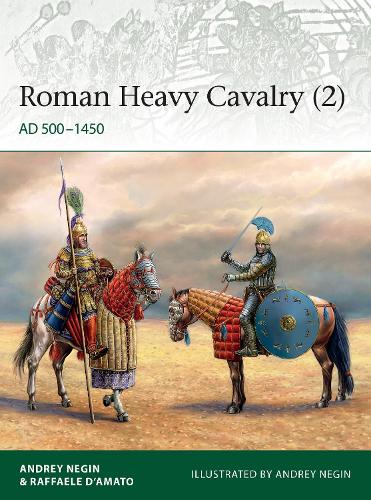
Roman Heavy Cavalry (2) :AD 500–1450 - Elite
paperback
Published:
26 November, 2020

Popular Books by Raffaele D’Amato
View All Books by Raffaele D’Amato
Description
In the twilight of the Western Roman Empire in the 5th–6th centuries, the elite of the field armies was the heavy armoured cavalry – the cataphracts, clad in lamellar, scale, mail and padded fabric armour.
After the fall of the West, the Greek-speaking Eastern or Byzantine Empire survived for nearly a thousand years, and cavalry remained predominant in its armies, with the heaviest armoured regiments continuing to provide the ultimate shock-force in battle.
Accounts from Muslim chroniclers show that the ironclad cataphract on his armoured horse was an awe-inspiring enemy: ‘...they advanced against you, iron-covered – one would have said that they advanced on horses which seemed to have no legs’. This up-to-date study, replete with stunning full-colour illustrations of the various units, offers an engaging insight into the fearsome heavy cavalry units that battled against the enemies of Rome’s Eastern Empire.
More Details
| Type | Book |
|---|---|
| ISBN13 | 9781472839503 |
| ISBN10 | 1472839501 |
| Number Of Pages | 64 |
| Item Weight | 247 g |
| Product Dimensions | 184 x 246 x 8 mm |
| Publisher / Reseller | Bloomsbury Publishing PLC |
| Format | paperback |
GoodReads Reviews
Author's Bio
Andrey Negin was born in Nizhny Novgorod, Russia, and graduated from Nizhny Novgorod State University. There, he is candidate of historical sciences (PhD), and a member of the department of history of the Ancient World and Classical Languages. His current area of study is ancient Roman armour, specifically researching Roman parade and ceremonial armour.
Raffaele D’Amato, PhD, is the author of some 40 books and numerous articles on the military of Ancient Greece, the Roman Empire, Byzantium and the Middle Ages. For two years he taught at Fatih University, Istanbul as a visiting professor. He currently works as a lawyer and as an external researcher for the Laboratory of the Danubian Provinces at the University of Ferrara, Italy which is part of the Scientific Committee.