Rot :An Imperial History of the Irish Famine
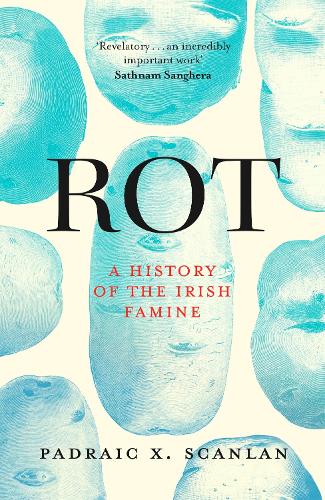
Rot :An Imperial History of the Irish Famine
hardback
Published:
13 March, 2025

Popular Books by Padraic X. Scanlan
View All Books by Padraic X. Scanlan
Description
'Captivating, notable, brilliant, thought-provoking'
A New Yorker Best Book of 2025
'A vigorous and engaging new study of the Irish famine . . . Richly underpinned by research in contemporary sources and firmly rooted in historical scholarship.' Fintan O'Toole
'Comprehensive, elegantly written and heartbreaking' John Banville
'A vivid, polemical narrative that does justice to victims and explains the ideologies that worsened the disaster.' Irish Independent
'Scanlan's history of the ''Great Hunger' and its repercussions is meticulous, measured and damning.' Financial Times
'Mr. Scanlan's haunting and terrible book is undoubtedly a history title of the year.' Wall Street Journal
In the 1800s, as Britain became the world's most powerful industrial empire, Ireland starved. The Great Famine fractured long-held assumptions about political economy and 'civilisation', threatening disorder in Britain. Ireland was a laboratory for empire, shaping British ideas about colonisation, population, ecology and work.
In Rot, Padraic Scanlan reinterprets the history of this time and the result is a revelatory account of Ireland's Great Famine. In the first half of the nineteenth century, nowhere in Europe - or the world - did the working poor depend as completely on potatoes as in Ireland. To many British observers, potatoes were evidence of a lack of modernity among the Irish. However, Ireland before the famine more closely resembled capitalism's future than its past. While poverty before and during the Great Famine was often blamed on Irish backwardness, it did in fact stem from the British Empire's embrace of modern capitalism.
Uncovering the disaster's roots in Britain's deep imperial faith in markets and capitalism, Rot reshapes our understanding of the Famine and its tragic legacy.
More Details
| Type | Book |
|---|---|
| ISBN13 | 9781472146878 |
| ISBN10 | 1472146875 |
| Number Of Pages | 352 |
| Item Weight | 564 g |
| Product Dimensions | 158 x 236 x 32 mm |
| Publisher / Reseller | Little, Brown Book Group |
| Format | hardback |
Media Reviews
Rot is a moving modern history of the Great Potato Famine. With great insight and impeccable research, Padraic Scanlan vividly brings this terrible catastrophe and the stories of its heroes and villains back to life. * Tyler Anbinder, author of City of Dreams *
Rot brilliantly blends economic, social, and environmental history to deliver a stunning new account of one of nineteenth-century Europe's most shameful tragedies. Padraic Scanlan joins clear-eyed, comprehensive research and analysis to deliver a persuasive indictment of faith in free markets. As illuminating as it is harrowing, Rot is a must-read for anybody interested in the histories of capitalism and empire. * Maya Jasanoff, author of The Dawn Watch *
Crisply written and based on an impressive range of contemporary sources, Padraic Scanlan's Rot is the best kind of historical writing. * Sean Connolly, author of On Every Tide *
Rot is a book I have longed to read. Framing the Irish Famine within the context of the British empire is revelatory. An incredibly important work. * Sathnam Sanghera, author of Empireworld *
GoodReads Reviews
Author's Bio
PADRAIC X. SCANLAN earned a BA (Hons) in History from McGill University in 2008, and a PhD in History from Princeton University in 2013. He is Associate Professor in the Centre for Industrial Relations and Human Resources and the Centre for Diaspora & Transnational Studies at the University of Toronto and a Research Associate at the Joint Centre for History and Economics at the University of Cambridge. He has also held appointments at the London School of Economics and Harvard University. He is the author of Freedom's Debtors, which, in 2018, was awarded the James A. Rawley Prize and the Wallace K. Ferguson Prize, and Slave Empire.