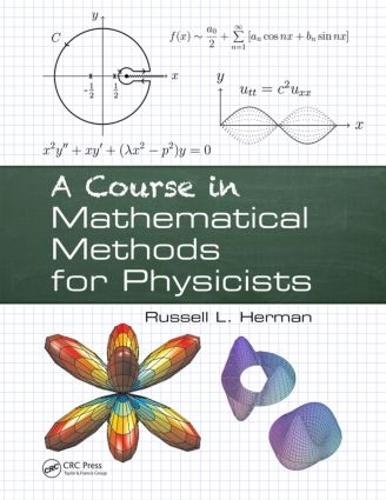
A Course in Mathematical Methods for Physicists
A Course in Mathematical Methods for Physicists
paperback
Published:
4 December, 2013

Popular Books by Russell L. Herman
View All Books by Russell L. Herman
Description
Based on the author’s junior-level undergraduate course, this introductory textbook is designed for a course in mathematical physics. Focusing on the physics of oscillations and waves, A Course in Mathematical Methods for Physicists helps students understand the mathematical techniques needed for their future studies in physics. It takes a bottom-up approach that emphasizes physical applications of the mathematics.
The book offers:
- A quick review of mathematical prerequisites, proceeding to applications of differential equations and linear algebra
- Classroom-tested explanations of complex and Fourier analysis for trigonometric and special functions
- Coverage of vector analysis and curvilinear coordinates for solving higher dimensional problems
- Sections on nonlinear dynamics, variational calculus, numerical solutions of differential equations, and Green's functions
More Details
| Type | Book |
|---|---|
| ISBN13 | 9781466584679 |
| ISBN10 | 146658467X |
| Number Of Pages | 776 |
| Item Weight | 1440 g |
| Publisher / Reseller | Taylor & Francis Inc |
| Format | paperback |
Media Reviews
"… a welcome and refreshing addition to a rich body of literature. … should fit into the sophomore or junior year of a typical physics undergraduate curriculum. … Engineers and chemistry majors, too, would benefit from taking such an intermediate-level course, perhaps even more so than from a higher-level one. Our own department at Howard University is considering a mid-level math methods course, and I would definitely recommend this textbook as well suited. A Course in Mathematical Methods for Physicists includes plenty of interesting worked-out examples, many of them quite realistic, and uses them to introduce concepts in a reasonable progression. …
Although the subject of mathematical methods has inspired many valuable texts, Herman’s approach, motivated by the physics applications, is novel, seldom used by other authors. The myriad well-chosen worked-out examples and other strengths have earned my firm endorsement …"
—Tristan Hübsch, Howard University, Washington, District of Columbia, USA, from Physics Today
Author's Bio
Russell L. Herman