Mitigating Drought Impacts in Drylands :Quantifying the Potential for Strengthening Crop and Livestock Based Livelihoods - World Bank Studies
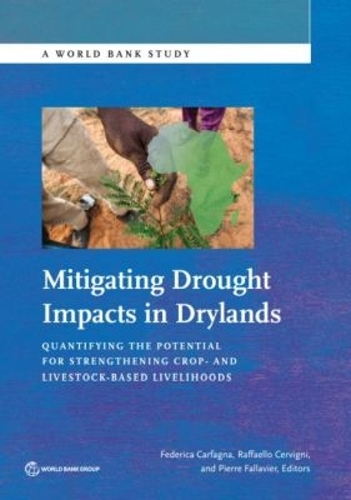
Mitigating Drought Impacts in Drylands :Quantifying the Potential for Strengthening Crop and Livestock Based Livelihoods - World Bank Studies
paperback
Published:
30 April, 2018

Popular Books by Raffaello Cervigni
View All Books by Raffaello Cervigni
Description
Such modelling framework consisted in a) estimating the baseline vulnerability profiles of people living in drylands (2010), b) estimate the evolution of vulnerability by 2030 under a range of assumptions, c) calculated the number of people affected by drought in the different administrative units of each country, and d) evaluate different types of interventions in agriculture and livestock for mitigating drought impact by calculating the potential for reducing the number of people affected for each scenario and conducting a simplified · benefit/cost (B/C) analysis for each type of intervention.
For livestock, simulation models were used to estimate the impacts of feed balances, livestock production, and household income resilience interventions under different climate scenarios). For agriculture, the DSSAT (Decision Support System for Agrotechnology Transfer) framework was used to assess the potential impact on yields likely to result from adoption of five crop farming technologies: (1) drought-tolerant varieties, (2) heat-tolerant varieties, (3) additional fertilizer, (4) agroforestry practices, (S) irrigation (6) water-harvesting techniques and selected combinations thereof.
More Details
| Type | Book |
|---|---|
| ISBN13 | 9781464812262 |
| ISBN10 | 1464812268 |
| Number Of Pages | 88 |
| Item Weight | 220 g |
| Product Dimensions | 177 x 254 x 5 mm |
| Publisher / Reseller | World Bank Publications |
| Format | paperback |
Author's Bio
The World Bank came into formal existence in 1945 following the international ratification of the Bretton Woods agreements. It is a vital source of financial and technical assistance to developing countries around the world. The organization's activities are focused on education, health, agriculture and rural development, environmental protection, establishing and enforcing regulations, infrastructure development, governance and legal institutions development. The World Bank is made up of two unique development institutions owned by its 185 Member Countries. The International Bank for Reconstruction and Development (IBRD) focuses on middle income and creditworthy poor countries and the International Development Association (IDA), which focuses on the poorest countries in the world.