Handbook of Writing Research, Third Edition
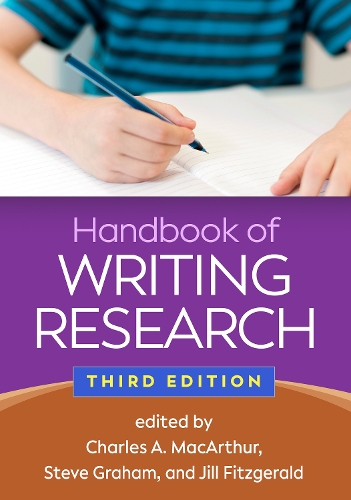
Handbook of Writing Research, Third Edition
paperback
Published:
17 June, 2025

Popular Books by Charles A. MacArthur
View All Books by Charles A. MacArthur
Description
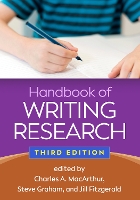
Synthesizing the breadth of current research on the teaching and learning of writing, the third edition of this definitive handbook has more than 90% new content, reflecting the growth and dynamism of the field. Leading scholars--including many international voices--review major theories, developmental issues, and instructional approaches for students at all grade levels. Cognitive and sociocultural aspects of writing are explored in depth, as are assessment principles and methods. Issues in teaching students with disabilities, multilingual students, and culturally diverse students are addressed. The volume discusses innovative research methods and educational technologies and identifies key directions for future investigation.
New to This Edition
- Chapters on executive functions in writing; disciplinary writing in math, science, and social studies; the role of vocabulary in writing; and formative assessment.
- Chapters on source-based writing, source evaluation, and writing development and instruction for African American students.
- Chapters on sociocultural aspects of writing--from critical literacies to agency and identity, social justice issues, and more--plus an emphasis on integrating cognitive and sociocultural perspectives throughout.
More Details
| Type | Book |
|---|---|
| ISBN13 | 9781462557271 |
| ISBN10 | 1462557279 |
| Number Of Pages | 480 |
| Item Weight | 880 g |
| Publisher / Reseller | Guilford Publications |
| Format | paperback |
| Edition | 3rd edition |
Media Reviews
"Teacher educators, researchers, and writing teachers will benefit greatly from the practical and theoretical perspectives in the third edition of this handbook. The volume explicates cognitive, sociocultural, and community-based models of writing, and--especially noteworthy--features a number of chapters that demonstrate progress in integrating these models. The third edition showcases many important studies that collectively reveal what is currently known about writing development and instruction in young children through adults from diverse backgrounds, while also noting the need to look ahead at generative AI and its impacts on writing processes and research.”--Sarah Warshauer Freedman, PhD, Distinguished Professor of the Graduate School, School of Education, University of California, Berkeley
“This handbook, now in its third edition, provides comprehensive knowledge of writing processes, instruction, and assessment for a range of age groups and ability levels. It is an essential resource for graduate students and writing researchers, and is highly appropriate for courses in special education and educational and school psychology. A good portion of the material is also relevant to the preparation of teachers of literacy, both in- and preservice. Many of the chapters promise to provide critically important foundations for future advances, such as understanding the role and use of AI in writing and preparing the workforce to meet the ever-increasing demand for writing skills.”--Dolores Perin, PhD, Professor Emerita of Psychology and Education, Teachers College, Columbia University
"Each edition of this state-of-the-art volume is eagerly awaited by writing researchers. The Handbook offers a well-calibrated compass to guide the field toward integration across cognitive and social dimensions of writing, reading–writing connections, and research–practice partnerships. Chapters capture the dynamic and evolving nature of writing and provide a wider understanding of writing difficulties. A 'must read' for literacy researchers, practitioners, and students worldwide."--Rui A. Alves, PhD, Faculty of Psychology and Education Sciences, University of Porto, Portugal
"Learning how to write well challenges not just students but also their instructors. The third edition of the Handbook provides a comprehensive and up-to-date resource for educators and researchers seeking to understand the complexities of written composition and how to teach it. New to this edition are helpful chapters on integrating the cognitive and social-cultural dimensions of writing and on the common task of writing from sources in secondary and college-level education. I found the chapters on computer-based writing assessment and writing instruction especially timely."--Ronald T. Kellogg, PhD, Department of Psychology (Emeritus), Saint Louis University
"Like its predecessors, this volume is comprehensive and definitive, including valuable bibliographies. The Handbook offers a fascinating perspective on how writing research is developing, for example, the substantial rise of sociocultural approaches. And we get a peek at the coming impact of AI and ChatGPT. This is a book every current researcher in composition and rhetoric needs to have close at hand."--Martin Nystrand, PhD, Louise Durham Mead Professor of English Emeritus, University of Wisconsin–Madison-This book as a whole is an amazing tour de force. Every chapter is informative, detailed, and instructive....Essential reading for those in the field, for those who want to know about it, and for those who want to join in. (on the first edition)--PsycCRITIQUES, 11/1/2006
GoodReads Reviews
Author's Bio
Charles A. MacArthur, PhD, is Professor Emeritus of Special Education and Literacy in the School of Education at the University of Delaware. A former special education teacher, Dr. MacArthur has been conducting research on writing development and instruction for struggling writers since the 1980s. Most recently, he was principal investigator on two grants to develop and examine the efficacy of a writing curriculum for college basic writing courses. Other research projects have focused on the development of a writing curriculum for students with learning disabilities, writing strategy instruction, decoding instruction in adult education, speech recognition as a writing accommodation, project-based learning in social studies in inclusive classrooms, and first-grade writing instruction. Dr. MacArthur is a Fellow of the American Educational Research Association and a recipient of a research award from the Council for Exceptional Children. He has served as coeditor of the Journal of Writing Research and the Journal of Special Education, has published over 125 articles and book chapters, and is coeditor or coauthor of several books.
Steve Graham, EdD, is a Regents Professor and the Warner Professor in the Division of Leadership and Innovation at Mary Lou Fulton Teachers College, Arizona State University. Since the 1980s, he has studied how writing develops, how to teach it effectively, and how it can be used to support reading and learning. Dr. Graham’s research involves typically developing writers and students with special needs in both elementary and secondary schools, with much of this research occurring in classrooms in urban schools. Dr. Graham is a recipient of the Thorndike Career Award from Division 15 of the American Psychological Association, the William S. Gray Citation of Merit from the International Literacy Association, and the Exemplary Research in Teaching and Teacher Education Award from Division K of the American Educational Research Association, among other awards. He is the former editor of several journals, including the Journal of Writing Research; coauthor of three influential Carnegie Corporation reports on writing; and coauthor or coeditor of several books.
Jill Fitzgerald, PhD, is Research Professor and Professor Emerita in the School of Education at The University of North Carolina at Chapel Hill. A former primary-grades teacher and reading specialist, she has most recently conducted research on literacy issues involving multilingual learners, text complexity, and vocabulary measurement. Dr. Fitzgerald is a member of the Reading Hall of Fame, a Fellow of the American Educational Research Association (AERA), and a recipient of research awards from Phi Delta Kappa, the International Literacy Association, and the AERA. She has published over 150 works, is currently associate editor of the [ital]Journal of Educational Psychology[/ital], and serves on the editorial boards of several other journals. Dr. Fitzgerald also has received university teaching and advisement awards and has been a review panelist for the U.S. Department of Education, the Institute of Education Sciences, the National Institutes of Health, and the National Institute for Literacy.