Noise-Induced Hearing Loss :Scientific Advances - Springer Handbook of Auditory Research
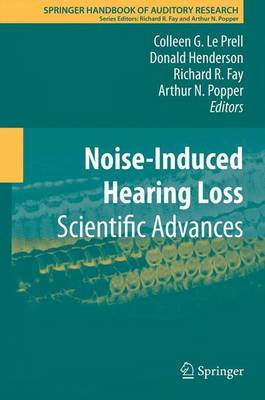
Noise-Induced Hearing Loss :Scientific Advances - Springer Handbook of Auditory Research
paperback
Published:
27 October, 2013

Popular Books by Donald Henderson
View All Books by Donald Henderson

Description
Exposure to loud noise continues to be the largest cause of hearing loss in the adult population. The problem of NIHL impacts a number of disciplines. US standards for permissible noise exposure were originally published in 1968 and remain largely unchanged today. Indeed, permissible noise exposure for US personnel is significantly greater than that allowed in numerous other countries, including for example, Canada, China, Brazil, Mexico, and the European Union. However, there have been a number of discoveries and advances that have increased our understanding of the mechanisms of NIHL. These advances have the potential to impact how NIHL can be prevented and how our noise standards can be made more appropriate.
More Details
| Type | Book |
|---|---|
| ISBN13 | 9781461429968 |
| ISBN10 | 146142996X |
| Number Of Pages | 378 |
| Item Weight | 1000 g |
| Publisher / Reseller | Springer-Verlag New York Inc. |
| Format | paperback |
| Edition | 2012 ed. |
Media Reviews
From the reviews:
“The book relates psychophysically, via loudness factors the damage which occurs to outer hair cells, inner hair cells, basilar membrane and the cochlea during high or low pitch loud auditory stimuli. … This book will be of great interest to psychophysicists, brain researchers, audiologists, ENT doctors, graduate students, advanced undergraduate neurophysiology majors, etc. I wholeheartedly recommend this book to the academic community.” (Joseph J. Grenier, Amazon.com, October, 2013)
“It is from a series of volumes on auditory research aimed at graduate students, post-doctoral researchers and clinical investigators … . It concentrates on recent advances in the understanding of mechanisms associated with NIHL. … the book points to the future use of therapeutic antioxidants and other agents as a potential protection for the inner ear! … for an occupational health practitioner, this is one for the reference library.” (Ian J. Lawson, Occupational Medicine, Vol. 62 (6), September, 2012)