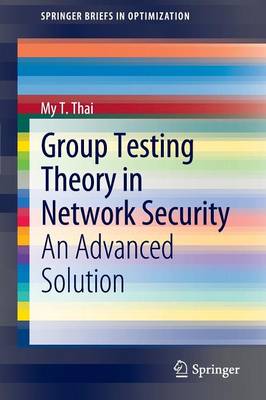
Group Testing Theory in Network Security :An Advanced Solution - SpringerBriefs in Optimization
Group Testing Theory in Network Security :An Advanced Solution - SpringerBriefs in Optimization
paperback
Published:
14 October, 2011

Popular Books by My T. Thai
View All Books by My T. Thai


Description
Group Testing Theory in Network Security explores a new branch of group testing theory with an application which enhances research results in network security. This brief presents new solutions on several advanced network security problems and mathematical frameworks based on the group testing theory, specifically denial-of-service and jamming attacks. A new application of group testing, illustrated in this text, requires additional theories, such as size constraint group testing and connected group testing. Included in this text is a chapter devoted to discussing open problems and suggesting new solutions for various network security problems. This text also exemplifies the connection between mathematical approaches and practical applications to group testing theory in network security. This work will appeal to a multidisciplinary audience with interests in computer communication networks, optimization, and engineering.
More Details
| Type | Book |
|---|---|
| ISBN13 | 9781461401278 |
| ISBN10 | 1461401275 |
| Number Of Pages | 86 |
| Item Weight | 1000 g |
| Publisher / Reseller | Springer-Verlag New York Inc. |
| Format | paperback |
Media Reviews
From the reviews:
“The topic of this monograph is at the crossroads of optimization, network security, graph theory, and algorithmic complexity. … The monograph is written in a compact and precise style. … Given the network architecture of modern communications, the topic is certainly timely. In sum, this monograph provides advanced solutions based on group testing to some particular threats to network security. Therefore, it is going to be very useful for researchers seeking a brief introduction to the state-of-art of this new and specialized methodology.” (José M. Amigó, Mathematical Reviews, January, 2013)