Urban Theory :A critical introduction to power, cities and urbanism in the 21st century
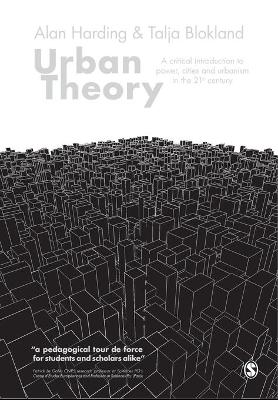
Urban Theory :A critical introduction to power, cities and urbanism in the 21st century
paperback
Published:
13 May, 2014

Popular Books by Alan Harding
View All Books by Alan Harding
Description
- Relations between urban theory and modernity in key ideas of the Chicago School, spatial analysis, humanistic urban geography, and ‘radical′ approaches like Marxism
- Cities and the transition to informational economies, globalization, urban growth machine and urban regime theory, the city as an "actor"
- Spatial expressions of inequality and key ideas like segregation, ghettoization, suburbanization, gentrification
- Socio-cultural spatial expressions of difference and key concepts like gender, sexuality, race, ethnicity and "culturalist" perspectives on identity, lifestyle, subculture
- How cities should be understood as intersections of horizontal and vertical – of coinciding resources, positions, locations, influencing how we make and understand urban experiences.
More Details
| Type | Book |
|---|---|
| ISBN13 | 9781446294529 |
| ISBN10 | 1446294528 |
| Number Of Pages | 312 |
| Item Weight | 530 g |
| Publisher / Reseller | SAGE Publications Ltd |
| Format | paperback |
Media Reviews
Just when we need it most, urban theory seems to be failing us. This book explains why we need it.
-- Jamie PeckHarding and Blokland address the vaunted "crisis" in urban theory with a thoughtful assessment of extant theories in terms of performance, commensurability, and critical engagement. In a conversational and lively tone, they view theories of inequality, public space, identity, power, agency, and culture through the lens of "relaxed urban theory." Excellent overview for scholars and engaging classroom material.
-- Susan E. ClarkeInspired by Peter Saunders’s non-spatial urban thinking, Harding and Blokland’s book provides a provocative, wide-ranging and comprehensive treatment of concepts geared to understand cities, and is a compulsory addition to any urban student’s intellectual arsenal in a period of renewed interest in urban theory. -- Roger Keil
Urban theory is said to be in a mess. Proceeding with great analytical clarity, this book introduces a relaxed definition of urban theory that enables the reader to make sense of the non-linear, variegated world of urban theory as it has developed over time and through the application of different disciplines, methods and epistemologies. In reviewing all the major conceptualisations of urban theory, Harding and Blokland provide clear insights into recent developments and the controversies and critiques they have provoked. The book is a pedagogical tour de force for students and scholars alike. -- Patrick Le Galès
GoodReads Reviews
Author's Bio
Alan Harding is Professor of Public Policy and Director of the Heseltine Institute for Public Policy and Practice at the University of Liverpool Management School in the UK. Previously, he held posts at Manchester, Salford and Liverpool John Moores universities. His research interests are in urban and regional development, governance and policy and he has acted as an advisor on these issues for a wide range of leading agencies with interests in this field. Talja Blokland (1971) is an urban sociologist who has worked at Yale University, the University of Manchester and various Dutch universities. Since 2009, she has held the chair of Urban and Regional Sociology at Humboldt University in Berlin. Her publications include Urban Bonds (Polity 2003), Networked Urbanism (edited with Mike Savage, Ashgate 2008) and various articles on race and ethnicity in the city, poor neighbourhoods, urban violence, gentrification, urban middle classes and neighbourhood relations and everyday interactions.