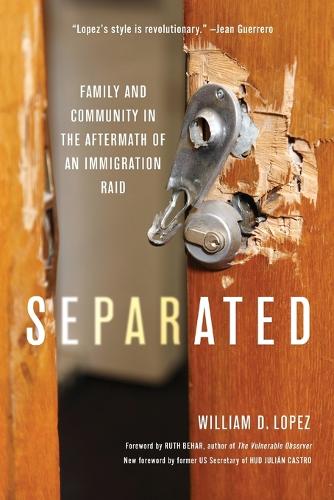
Separated :Family and Community in the Aftermath of an Immigration Raid
Separated :Family and Community in the Aftermath of an Immigration Raid
paperback
Published:
24 August, 2021

Popular Books by William D. Lopez
View All Books by William D. Lopez
Description
William D. Lopez details the incredible strain that immigration raids place on Latino communities—and the families and friends who must recover from their aftermath.
2020 International Latino Book Awards Winner First Place, Mariposa Award for Best First Book - Nonfiction Honorable Mention, Best Political / Current Affairs Book
On a Thursday in November 2013, Guadalupe Morales waited anxiously with her sister-in-law and their four small children. Every Latino man who drove away from their shared apartment above a small auto repair shop that day had failed to return—arrested, one by one, by ICE agents and local police. As the two women discussed what to do next, a SWAT team clad in body armor and carrying assault rifles stormed the room. As Guadalupe remembers it, "The soldiers came in the house. They knocked down doors. They threw gas. They had guns. We were two women with small children . . . The kids terrified, the kids screaming."
In Separated, William D. Lopez examines the lasting damage done by this daylong act of collaborative immigration enforcement in Washtenaw County, Michigan. Exploring the chaos of enforcement through the lens of community health, Lopez discusses deportation's rippling negative effects on families, communities, and individuals. Focusing on those left behind, Lopez reveals their efforts to cope with trauma, avoid homelessness, handle worsening health, and keep their families together as they attempt to deal with a deportation machine that is militarized, traumatic, implicitly racist, and profoundly violent.
Lopez uses this single home raid to show what immigration law enforcement looks like from the perspective of the people who actually experience it. Drawing on in-depth interviews with twenty-four individuals whose lives were changed that day in 2013, as well as field notes, records obtained under the Freedom of Information Act, and his own experience as an activist, Lopez combines rigorous research with moving storytelling. Putting faces and names to the numbers behind deportation statistics, Separated urges readers to move beyond sound bites and consider the human experience of mixed-status communities in the small towns that dot the interior of the United States.
Prizes
Winner of International Latino Book Awards: Best First Book - Nonfiction 2020 (United States),Runner-up for International Latino Book Awards: Best Political/Current Affairs Book 2020 (United States)
More Details
| Type | Book |
|---|---|
| ISBN13 | 9781421441788 |
| ISBN10 | 1421441780 |
| Number Of Pages | 232 |
| Item Weight | 340 g |
| Product Dimensions | 152 x 229 x 15 mm |
| Publisher / Reseller | Johns Hopkins University Press |
| Format | paperback |
Media Reviews
Lopez's book is one of the most powerful examples to date of an academic using deep study and radical empathy to indict a profoundly evil system.
—New Republic
Lopez's style is revolutionary. He demonstrates that an alleged criminal can be a complex human with complex human connections. His book short-circuits narratives at the root of racist policies—about good vs. bad immigrants, legal vs. illegal people—by honoring the complex web around the sinners. When brown sinners are outlawed, their loved ones become prey, too.
Separated is the result of hours of interviews with those affected, offering gumshoe FOIA-heavy journalism and a deep, empathetic understanding of community.
—Remezcla
No social issues collection, particularly those strong in community makeup and immigration challenges, should be without this hard-hitting survey.
—Donovan's Literary Services
Author's Bio
William D. Lopez is a clinical assistant professor at the School of Public Health and a faculty associate in the Latina/o Studies Program at the University of Michigan.