Energy Humanities :An Anthology
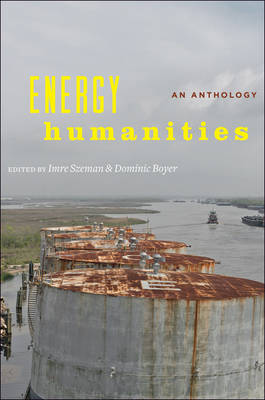
Energy Humanities :An Anthology
paperback
Published:
4 April, 2017

Popular Books by Imre Szeman
View All Books by Imre Szeman
Description
More Details
| Type | Book |
|---|---|
| ISBN13 | 9781421421896 |
| ISBN10 | 1421421895 |
| Number Of Pages | 616 |
| Item Weight | 839 g |
| Product Dimensions | 156 x 235 x 37 mm |
| Publisher / Reseller | Johns Hopkins University Press |
| Format | paperback |
Media Reviews
Energy Humanities is an ambitious and stimulating collection that will assist the reader in understanding the importance of explicitly engaging with energy across the arts, humanities and social sciences. It is equally suited for undergraduate students and advanced academics who are interested in exploring the fecundity of interdisciplinary discussion and creative critique.
—Capitalism, Nature, Socialism
While the collection serves scholars in offering an organization of a specific context that is still emerging, and will most likely keep growing in importance in the 21st century, this publication will most definitely prove useful as a way to introduce students to the questions of energy as a specific subfield of the arts, humanities and social sciences.
—Center for Energy and Environmental Research in the Human Sciences
Explore[s] ways of thinking and talking about the environment more creatively, aiming to circumvent our denial and despair, so that we may learn how to dwell on the things that are disappearing, and to carry on living in the world they leave behind.
—Clare Saxby, Times Literary Supplement
GoodReads Reviews
Author's Bio
Imre Szeman holds the Canada Research Chair in Cultural Studies at the University of Alberta and is the cofounder of the Petrocultures Research Group. He is the coauthor of After Oil and the coeditor of The Johns Hopkins Guide to Literary Theory and Criticism. Dominic Boyer is a professor of anthropology at Rice University and the founding director of the Center for Energy and Environmental Research in the Human Sciences. He is the coauthor of Theory Can Be More than It Used to Be: Learning Anthropology's Method in a Time of Transition.