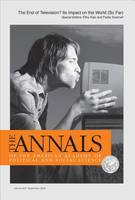
The End of Television? :Its Impact on the World (So Far) - The ANNALS of the American Academy of Political and Social Science Series
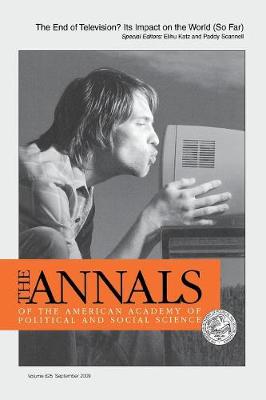
The End of Television? :Its Impact on the World (So Far) - The ANNALS of the American Academy of Political and Social Science Series
paperback
Published:
17 September, 2009

Popular Books by Elihu Katz
View All Books by Elihu Katz
Description
That early stage of "sharedness" and "scarcity" gave way to the television of "plenty," when satellite and cable and competition reigned, choice was suddenly expanded, and every room in the home had its own television set. And now television offers infinite choices where we can view what we like; when we like; where we like; on a variety of screens, telephones, and Web sites. Some researchers assert that television is not dead but has merely moved from a "collectivist" to an "individualist" phase.
Throughout the drastic evolution of this media, thousands of studies have examined the short-term effects of television, such as the evaluation of persuasion campaigns. Yet there is scant research on the overreaching sociological impacts of television and its centrality to Western culture over the past 60 years. This compelling volume of The ANNALS is the first collection of rigorous articles devoted to studying ways in which television has impacted our values, ideologies, institutions, social structure, and culture.
Focusing on classic television, these leading experts in media studies delve into the effects on social institutions (namely family and politics) and its effects on values and everyday behavior. These seminal articles lay the groundwork for innovative studies of the numerous ways that television has impacted democracy; social integration (nation and family); trust and suspiciousness; materialism; and identity (social and physical). Students and researchers will find a wealth of inspiration for new research projects. It is a must-have resource for social scientists interested in media studies.
More Details
| Type | Book |
|---|---|
| ISBN13 | 9781412978521 |
| ISBN10 | 1412978521 |
| Number Of Pages | 236 |
| Item Weight | 370 g |
| Publisher / Reseller | SAGE Publications Inc |
| Format | paperback |
GoodReads Reviews
Author's Bio
Paddy Scannell worked for many years at the University of Westminster (London) where he and his colleagues established, in 1975, the first undergraduate degree program in Media Studies in the UK. He is a founding editor of Media, Culture and Society which began publication in 1979 and is now issued six times yearly. He is the author of A Social History of British Broadcasting, 1922-1939 which he wrote with David Cardiff, editor of Broadcast Talk and author of Radio, Television and Modern Life. He is currently working on a trilogy. The first volume, Media and Communication, was published in June 2007. Professor Scannell is now working on the second volume, Television and the Meaning of ′Live.′ The third volume, Love and Communication, is in preparation. His research interests include broadcasting history and historiography, the analysis of talk, the phenomenology of communication and culture and communication in Africa.