Networked Disease :Emerging Infections in the Global City - IJURR Studies in Urban and Social Change Book Series
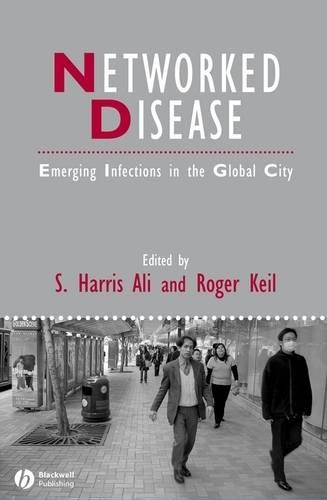
Networked Disease :Emerging Infections in the Global City - IJURR Studies in Urban and Social Change Book Series
paperback
Published:
19 September, 2008

Popular Books by S. Harris Ali
View All Books by S. Harris Ali

Description
- Presents original contributions by scholars from seven countries on four continents
- Connects newer thinking on global cities, networks, and governance in a post-national era of public health regulations and neo-liberalization of state services
- Provides an important contribution to the global public debate on the challenges of emerging infectious disease in cities
- Examines the impact of globalization on future infectious disease threats on international and local politics and culture
- Focuses on the ways pathogens interact with economic, political and social factors, ultimately presenting a threat to human development and global cities
- Employs an interdisciplinary approach to the SARS epidemic, clearly demonstrating the value of social scientific perspectives on the study of modern disease in a globalized world
More Details
| Type | Book |
|---|---|
| ISBN13 | 9781405161343 |
| ISBN10 | 1405161345 |
| Number Of Pages | 384 |
| Item Weight | 553 g |
| Product Dimensions | 152 x 229 x 21 mm |
| Publisher / Reseller | John Wiley and Sons Ltd |
| Format | paperback |
Media Reviews
?Much interesting material and probing analysis can be found in this text, which is suitable for graduate students and academics concerned with the intersection between cities and health.? (Canadian Journal of Sociology, Summer 2009)
?This is a unique book that examines emerging infectious diseases through the lens of sociologists and would be an interesting reference for public-health practitioners, travel-health experts, infectious disease physicians, sociologists, and political scientists.? (The Lancet.com, October 2009)
"In this unique and invaluable reconstruction of how the deadly SARS virus hitchhiked from China to Canada in 2002?03, we are squarely confronted with the enormous inadvertent biological consequences of economic globalization and the emergence of so-called 'world cities'."
Mike Davis, University of California, Irvine
"As both an urban/environmental sociologist and resident of Toronto during the 2003 SARS crisis, I have the highest praise for Networked Disease. The contributors have done a masterful job identifying the practical and theoretical challenges associated with the global spread of emerging infectious diseases. This cutting edge material should seriously engage academics, students, and practitioners in social geography, urban studies, public health, and environmental sociology."
John Hannigan, University of Toronto
Author's Bio
S. Harris Ali is a trained Environmental Sociologist and an Associate Professor at the Faculty of Environmental Studies at York University, Toronto. His research interests involve the study of environmental health issues and the sociology of disasters and risk from an interdisciplinary perspective. He has published on toxic contamination events and disease outbreaks in such journals as Social Problems, Social Science and Medicine, The Canadian Review of Sociology and Anthropology, and the Journal of Canadian Public Policy.
Roger Keil is the Director of the City Institute, and Professor at the Faculty of Environmental Studies, at York University, Toronto. His publications include Los Angeles: Urbanization, Globalization and Social Struggles; Nature and the City: Making Environmental Policy in Toronto and Los Angeles; and The Global Cities Reader. Keil is the co-editor of the International Journal of Urban and Regional Research and a member of the International Network for Urban Research and Action.