Big Ideas in Forensic Psychology :Visions of a Forensic Future From Leading Voices in the Field - Wiley Series in Psychology of Crime, Policing and Law
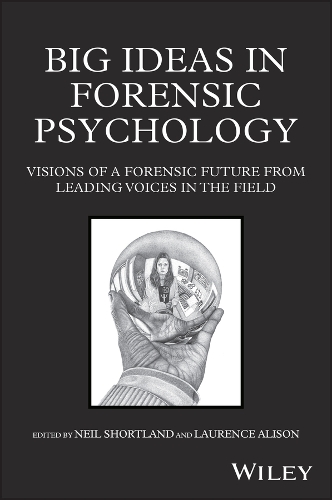
Big Ideas in Forensic Psychology :Visions of a Forensic Future From Leading Voices in the Field - Wiley Series in Psychology of Crime, Policing and Law
paperback
Pre-Order Published On:
30 July, 2026

Popular Books by Neil Shortland
View All Books by Neil Shortland
Description
A field guide to the next decade of forensic psychology—40 innovative ideas that will influence investigations, courts, and correctional decision-making
In Big Ideas in Forensic Psychology: 40 Innovations that will Define the Future of the Field, Professors Neil Shortland (Director, Centre for Terrorism and Security Studies, UMass Lowell) and Laurence Alison MBE (Director, CAMI Research, University of Liverpool) curate an insightful and provocative look at what’s coming next in policing, corrections, and criminal law decision-making. Drawing on contributors who span policing, courts, corrections, intelligence, and security, the book tackles the hard problems practitioners face – false confessions, biased decision rules, digital crime, AI-enabled workflows – and shows how to address them with defensible, research-anchored methods.
Organized as a fast, “annual question”–style collection, each chapter answers: What big idea will change the field in the next ten years? The result is a panoramic and rigorous map of near-term shifts: science-based interviewing beyond confession seeking, rights-consistent detention and oversight, digital-trace analytics for threat assessment, simulation-driven training, and the governance of frontier AI. As the launch title in the refreshed Wiley Series in the Psychology of Crime, Policing and Law, it situates these ideas within the series’ broad focus – from courtroom psychology to extreme-team decision support – giving readers both immediate takeaways and a durable research agenda for practice.
A deliberately cross-sector view – chapters from senior detectives, trial consultants, clinical evaluators, intelligence specialists, and methodologists – distills what will actually change interviews, hearings, and field operations on Monday morning
This resource offers:
- Concrete, testable advances: SUE-informed questioning, verbal baselining 2.0, rapport-based interrogation, and live-time intelligence provenance—each framed with constraints, failure modes, and implementation steps
- Technology with guardrails: practical blueprints for using AI in investigations, risk triage, and simulation training—paired with governance principles to avoid rights violations and model-drift harms
- Law and policy integration: chapters on virtual courts, prosecutorial communication with CSA survivors, plea validity, and judicial decision-making research pipelines—bridging bench, bar, and behavioral science
- Threat and prevention, not just post-incident response: leakage analysis, grievance-fueled violence models, and environmental harm-reduction strategies grounded in transparent data practices
Perfect for investigative leaders, interview trainers, forensic clinicians, courtroom psychologists, threat assessment teams, and methodologists responsible for evidence standards, Big Ideas in Forensic Psychology will also benefit policy makers, prosecutors/defense, judicial researchers, and graduate programs aligning curricula to real-world constraints. The compresses state-of-the-art, field-tested ideas into actionable, defensible guidance that anticipates the technology and governance pressures already reshaping practice in the real world.
More Details
| Type | Book |
|---|---|
| ISBN13 | 9781394289769 |
| ISBN10 | 1394289766 |
| Number Of Pages | 256 |
| Item Weight | 1000 g |
| Publisher / Reseller | John Wiley & Sons Inc |
| Format | paperback |
Author's Bio
Professor Neil Shortland, Ph.D., is Director of the Centre for Terrorism and Security Studies and Professor in Criminology & Criminal Justice at the University of Massachusetts Lowell. His funded research portfolio spans the U.S. Army Research Institute, DoD, ONR, NSF, UK MoD, and DARPA, with a focus on high-stakes choice, human-AI interaction, and stress effects on decision-making.
Professor Laurence Alison, Ph.D., MBE is Director of Critical and Major Incident Research at the University of Liverpool and Academic Director of the HYDRA Foundation. A recognized authority on investigative decision-making and rapport-based interrogation, he advises UK and U.S. agencies (including FBI/CIA/DoD) and leads work across disaster management, terrorism, and high-risk operations.