The Making of Modern Kosovo :Reassessing Ibrahim Rugova’s Policy of Non-Violence
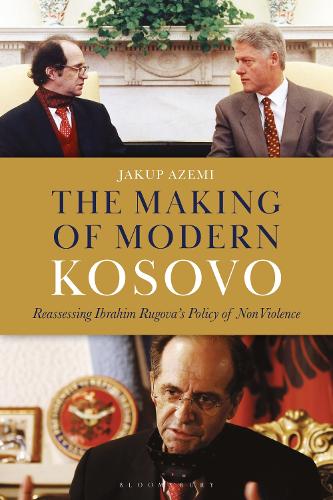
The Making of Modern Kosovo :Reassessing Ibrahim Rugova’s Policy of Non-Violence
paperback
Published:
24 July, 2025

Description
This book traces the origins and success of Ibrahim Rugova’s policy of nonviolence in Kosovo between 1989–1999 and how it laid the framework for the creation of Kosovo’s cultural and political identity as an independent state.
Ibrahim Rugova has long been neglected in understanding how Kosovo became an independent state, with most observers concentrating on the Kosovo Liberation Army and the armed conflict of 1999 in which NATO was involved. Jakup Azemi seeks to remedy this, arguing that despite the events of 1998/99, local actors and their political organisation mattered much more than is widely recognised. Rugova’s movement represented a novelty not only for the Albanians but for the whole Balkan region. He developed a vision that integrated Albanians’ cultural and historical experiences into the non-violent movement and presented the Kosovan conflict to the world with a different political and cultural lens.
This is a key text for scholars interested in the history of the Kosovar liberation movement, the dissolution of the former Yugoslavia; and those looking at current issues in the Western Balkans, and the Albanian-Kosovar relationship.
More Details
| Type | Book |
|---|---|
| ISBN13 | 9781350460065 |
| ISBN10 | 1350460060 |
| Number Of Pages | 256 |
| Item Weight | 380 g |
| Product Dimensions | 154 x 232 x 18 mm |
| Publisher / Reseller | Bloomsbury Publishing PLC |
| Format | paperback |
Media Reviews
A fascinating analysis of Rugova’s policy of non-violence in Kosovo… Azemi’s argument is authoritative and should be read by all who seek to understand Kosovo’s historical evolution. * Aidan Hehir, University of Westminster, UK *
Ibrahim Rugova is often referred to as “neo-Gandhian”. His policy of non-violent resistance should not be misunderstood as weakness. It was a calculated strategy to mobilize international support for Kosovo’s independence. Obdurate and determined, Rugova sought to avoid a blood bath by using passive resistance to advance Kosovo’s national aspirations. He ranks alongside Nelson Mandela and the Dalai Lama as great champions of peace”. * David L Phillips, Columbia University, USA *
Author's Bio
Jakup Azemi is affiliated with the School of Slavonic and East European Studies at University College London, UK, where his research primarily focuses on the political history of Kosovo. Over the years, he has frequently contributed to Kosovo and Albanian media on political affairs related to Albanians in the Balkans.