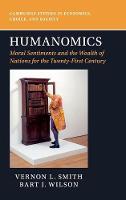
Humanomics :Moral Sentiments and the Wealth of Nations for the Twenty-First Century - Cambridge Studies in Economics, Choice, and Society
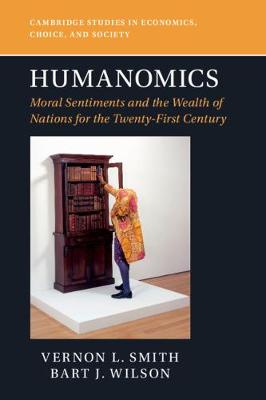
Humanomics :Moral Sentiments and the Wealth of Nations for the Twenty-First Century - Cambridge Studies in Economics, Choice, and Society
paperback
Published:
24 January, 2019

Popular Books by Vernon L. Smith
View All Books by Vernon L. Smith
Description
More Details
| Type | Book |
|---|---|
| ISBN13 | 9781316648810 |
| ISBN10 | 1316648818 |
| Number Of Pages | 234 |
| Item Weight | 340 g |
| Product Dimensions | 152 x 228 x 14 mm |
| Publisher / Reseller | Cambridge University Press |
| Format | paperback |
Media Reviews
'The new economics has arrived, a 'humanomics' that leaves the humans in. It banishes the sociopath known as Max U without repopulating the economy with idiots to be nudged by overlords. Humanomics combines the sacred and the profane, just as we do. It is a scientific, and ethical, triumph.' Deirdre Nansen McCloskey, University of Illinois at Chicago, author of Bourgeois Equality: How Ideas, Not Capital or Institutions, Enriched the World
'There are really three significant treatises in this book: first, building on their famous experimental work, Vernon L. Smith and Bart J. Wilson offer an exciting, theoretical framework for economics and the human sciences more generally. They do so, second, by offering a 'sympathetic retrospective hearing' of Adam Smith's (other) great book, The Theory of Moral Sentiments. Third, they offer a new philosophy of economics that does justice to their own practice and invites us all of to become participants in what they call humanomics. There are big and bold ideas packed into this monograph; yet the writing is accessible and down to earth. It's the kind of book you will be happy to assign to students, and while teaching it you will discover lots of urgent, new research projects.' Eric Schliesser, University of Amsterdam
'This marvelous book shows how engaging Adam Smith can help us to 'humanize' social science for the twenty-first century. Economists in particular will find much food for thought in its novel approach to using models derived from Smith's ethics to rethink many familiar and less-familiar experimental results. But it's not only economists who will profit from it; indeed anyone interested in what it means to be a human being living in two realms at once - the economic and the personal, the self-regarding and the other-regarding - will benefit from the authors' masterful illumination of how our human world is in fact 'moral all the way down'.' Ryan Patrick Hanley, Marquette University, Wisconsin and author of Love's Enlightenment: Rethinking Charity in Modernity
'… the authors of the book are world-class specialists, who 'have been reading and citing Adam Smith's 1759 The Theory of Moral Sentiments for well in excess of a decade' … one simply cannot miss reading it.' Jacek Klich, Central Banking Journal
Author's Bio
Vernon L. Smith is the George L. Argyros Endowed Chair in Economics and Finance at Chapman University, California. He was awarded the Noble Prize in Economic sciences in 2002 for, 'having established laboratory experiments as a tool in empirical economic analysis, especially in the study of alternative market mechanisms'. He is a founding member of Chapman University's Economic Science Institute and Smith Institute for Political Economy and Philosophy, and is a Distinguished Fellow of the American Economic Association. Bart J. Wilson is the Donald P. Kennedy Endowed Chair in Economics and Law at Chapman University, California. He is a founding member of the Economic Science Institute and founding member and Director of the Smith Institute for Political Economy and Philosophy. He has been co-teaching humanomics courses for nearly a decade with professors in the Departments of English and Philosophy.