Essentials of Understanding Abnormal Behavior
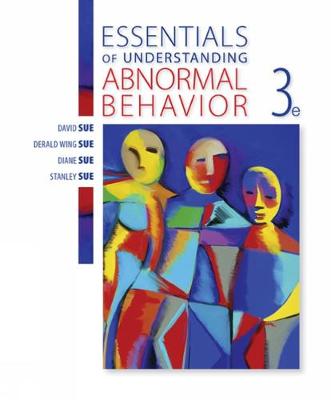
Essentials of Understanding Abnormal Behavior
paperback
Published:
1 January, 2016

Popular Books by David Sue
View All Books by David Sue

Description
More Details
| Type | Book |
|---|---|
| ISBN13 | 9781305639997 |
| ISBN10 | 1305639995 |
| Number Of Pages | 576 |
| Item Weight | 1410 g |
| Product Dimensions | 88 x 9 x 108 mm |
| Publisher / Reseller | Cengage Learning, Inc |
| Format | paperback |
| Edition | 3rd edition |
GoodReads Reviews
Author's Bio
David Sue is professor emeritus of psychology at Western Washington University, where he is an associate of the Center for Cross-Cultural Research. Additionally, He has served as director of the Psychology Counseling Clinic and the Mental Health Counseling Program. Dr. Sue's research interests revolve around multicultural issues in individual and group counseling. He and his wife co-authored COUNSELING AND PSYCHOTHERAPY IN A DIVERSE SOCIETY, and he is co-author of COUNSELING THE CULTURALLY DIVERSE: THEORY AND PRACTICE. He received his Ph.D. in clinical psychology from Washington State University. Derald Wing Sue is professor of psychology and education in the Department of Counseling and Clinical Psychology at Teachers College, Columbia University. He has written extensively in the field of multicultural counseling/therapy, microaggression theory and racial dialogues. He is the author of bestselling COUNSELING THE CULTURALLY DIVERSE: THEORY AND PRACTICE. A former president of both the Society of Counseling Psychology and the Society for the Psychological Study of Ethnic Minority Issues, Dr. Sue has been honored with numerous awards for teaching and service. He received his doctorate from the University of Oregon. Diane M. Sue has worked as a school psychologist and counselor, as well as with adults needing specialized care for mental illness and neurocognitive disorders. Her areas of expertise include child and adolescent psychology, aging and neuropsychology. She co-authored COUNSELING AND PSYCHOTHERAPY IN A DIVERSE SOCIETY and is the author of REMARKABLE RESILIENCE: THE LIFE AND LEGACY OF NOÉMI BAN BEYOND THE HOLOCAUST. A former adjunct faculty member at Western Washington University, Dr. Sue received the Western Washington University College of Education Professional Excellence Award and the Washington State School Psychologist of the Year Award. She received her Ed.S. in school psychology and her Ph.D. in educational psychology from the University of Michigan, Ann Arbor. Stanley Sue is distinguished professor emeritus of psychology at the University of California, Davis and at Palo Alto University. He was assistant and associate professor of psychology at the University of Washington (1971-1981); professor of psychology at UCLA (1981-1996); and professor of psychology at UC Davis (1996-2010). Dr. Sue served as the 2010 president of the Western Psychological Association. He also served as Planning Board member and Supplement Science Editor for the U.S. Surgeon General's Report on Mental Health (2001).