Neuroliberalism :Behavioural Government in the Twenty-First Century - Economics in the Real World
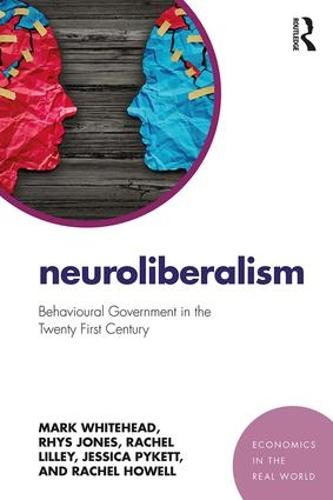
Neuroliberalism :Behavioural Government in the Twenty-First Century - Economics in the Real World
paperback
Published:
6 September, 2017

Popular Books by Mark Whitehead
View All Books by Mark Whitehead





Description
Many governments in the developed world can now best be described as ‘neuroliberal’: having a combination of neoliberal principles with policy initiatives derived from insights in the behavioural sciences.
Neuroliberalism presents the results of the first critical global study of the impacts of the behavioural sciences on public policy and government actions, including behavioural economics, behavioural psychology and neuroeconomics. Drawing on interviews with leading behaviour change experts, organizations and policy-makers, and discussed in alignment with a series of international case studies, this volume provides a critical analysis of the ethical, economic, political and constitutional implications of behaviourally oriented government. It explores the impacts of the behavioural sciences on everyday life through a series of themes, including: understandings of the human subject; interpretations of freedom; the changing form and function of the state; the changing role of the corporation in society; and the design of everyday environments and technologies.
The research presented in this volume reveals a diverse set of neuroliberal approaches to government that offer policy-makers and behaviour change professionals a real choice in relation to the systems of behavioural government they can implement. This book also argues that the behavioural sciences have the potential to support much more effective systems of government, but also generate new ethical concerns that policy-makers should be aware of.
More Details
| Type | Book |
|---|---|
| ISBN13 | 9781138923836 |
| ISBN10 | 1138923834 |
| Number Of Pages | 224 |
| Item Weight | 380 g |
| Publisher / Reseller | Taylor & Francis Ltd |
| Format | paperback |
Media Reviews
'[This book] shows how Behavioural Insights ‘works’ in a politico-strategic sense. It brings a deeper historical understanding and sketches out interesting (alternative) directions – such as ‘collaborative nudging’ – for the field. In a time in which ‘what works’ dominates in both policy research and policy practice, this book therefore provides a refreshing reflection.' - Joram Feitsma, Utrecht University
‘Indispensable and provocative reading for everyone interested in behavioral science, and its growing impact on everyday life. A terrific, fact-filled overview, it is also genuinely original, and it manages a neat trick. It is both highly illuminating and a lot of fun!’ — Cass R. Sunstein, co-author of Nudge and former Administrator, White House Office of Information and Regulatory Affairs
‘An outstanding critical contribution to debates on behavioural change. Neuroliberalism carefully articulates the impacts of the behavioural sciences on public policy and illustrates the ways in which neuroliberal government is both promoted and contested. It offers a unique insight into the history, philosophy and practice of "behavioural government" that we should all take note of.’ — Stewart Barr, Professor of Geography, University of Exeter, UK.
Author's Bio
Mark Whitehead is Professor of Human Geography at Aberystwyth University, Wales, UK. Rhys Jones is Professor and Head of Department (Geography) at Aberystwyth University, Wales, UK. Rachel Lilley is a behaviour change and mindfulness consultant and PhD Candidate at Aberystwyth University, Wales, UK. Jessica Pykett is Senior Lecturer in Human Geography at University of Birmingham, UK. Rachel Howell is Lecturer in Sociology and Sustainable Development at University of Edinburgh, Scotland, UK.