The Neighborhood in the Internet :Design Research Projects in Community Informatics - Routledge Advances in Sociology
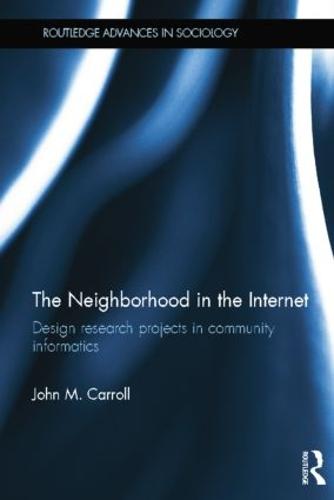
The Neighborhood in the Internet :Design Research Projects in Community Informatics - Routledge Advances in Sociology
paperback
Published:
14 March, 2014

Popular Books by John M. Carroll
View All Books by John M. Carroll


Description
Today, "community" seems to be everywhere. At home, at work, and online, the vague but comforting idea of the community pervades every area of life. But have we lost the ability truly to understand what it means? The Neighborhood in the Internet investigates social and civic effects of community networks on local community, and how community network designs are appropriated and extended by community members.
Carroll uses his conceptual model of "community" to re-examine the Blacksburg Electronic Village – the first Web-based community network – applying it to attempts to sustain and enrich contemporary communities through information technology. The book provides an analysis of the role of community in contemporary paradigms for work and other activity mediated by the Internet. It brings to the fore a series of design experiments investigating new approaches to community networking and addresses the future trajectory and importance of community networks.
This book will be of interest to students of sociology, community psychology, human-computer interaction, information science, and computer-supported collaborative work.
More Details
| Type | Book |
|---|---|
| ISBN13 | 9781138020054 |
| ISBN10 | 1138020052 |
| Number Of Pages | 256 |
| Item Weight | 470 g |
| Publisher / Reseller | Taylor & Francis Ltd |
| Format | paperback |
Author's Bio
John M. Carroll is Edward Frymoyer Professor of Information Sciences and Technology at the Pennsylvania State University. His research is in methods and theory in human-computer interaction, particularly as applied to networking tools for collaborative learning and problem solving, and design of interactive information systems. His books include Rationale-Based Software Engineering (Springer, 2008, with J. Burge, R. McCall and I. Mistrik), and Learning in Communities (Springer, 2009).