Understanding the Discrete Element Method :Simulation of Non-Spherical Particles for Granular and Multi-body Systems
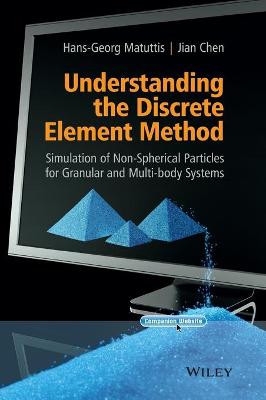
Understanding the Discrete Element Method :Simulation of Non-Spherical Particles for Granular and Multi-body Systems
hardback
Published:
24 June, 2014
hardback
Published:
24 June, 2014

Standard worldwide delivery by
Tue, July 14 - Fri, July 17
Order within
0
Condition:
NEW
$161.88
RRP
$167.38
You save $5.50 (3%)
Available
20+
in stock
FREE Returns within 30 days
Popular Books by Jian Chen
View All Books by Jian Chen









Description
Gives readers a more thorough understanding of DEM and equips researchers for independent work and an ability to judge methods related to simulation of polygonal particles
- Introduces DEM from the fundamental concepts (theoretical mechanics and solidstate physics), with 2D and 3D simulation methods for polygonal particles
- Provides the fundamentals of coding discrete element method (DEM) requiring little advance knowledge of granular matter or numerical simulation
- Highlights the numerical tricks and pitfalls that are usually only realized after years of experience, with relevant simple experiments as applications
- Presents a logical approach starting withthe mechanical and physical bases,followed by a description of the techniques and finally their applications
- Written by a key author presenting ideas on how to model the dynamics of angular particles using polygons and polyhedral
- Accompanying website includes MATLAB-Programs providing the simulation code for two-dimensional polygons
Recommended for researchers and graduate students who deal with particle models in areas such as fluid dynamics, multi-body engineering, finite-element methods, the geosciences, and multi-scale physics.
More Details
| Type | Book |
|---|---|
| ISBN13 | 9781118567203 |
| ISBN10 | 111856720X |
| Number Of Pages | 448 |
| Item Weight | 871 g |
| Product Dimensions | 178 x 252 x 27 mm |
| Publisher / Reseller | John Wiley & Sons Inc |
| Format | hardback |
See More +
Author's Bio
Hans-Georg Matuttis, The University of Electro-Communications, Japan
Jian Chen, RIKEN Advanced Institute for Computational Science, Japan