Atlas of Benthic Foraminifera
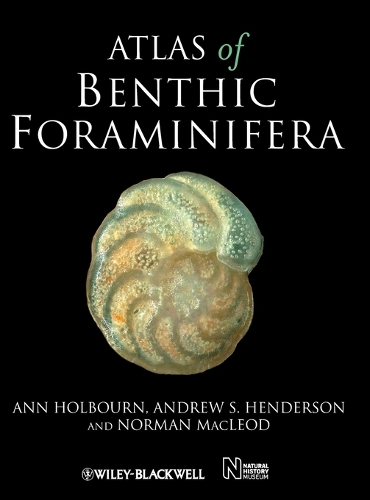
Atlas of Benthic Foraminifera
hardback
Published:
17 May, 2013

Description
An up-to-date atlas of an important fossil and living group, with the Natural History Museum.
Deep-sea benthic foraminifera have played a central role in biostratigraphic, paleoecological, and paleoceanographical research for over a century. These single–celled marine protists are important because of their geographic ubiquity, distinction morphologies and rapid evolutionary rates, their abundance and diversity deep–sea sediments, and because of their utility as indicators of environmental conditions both at and below the sediment–water interface. In addition, stable isotopic data obtained from deep–sea benthic foraminiferal tests provide paleoceanographers with environmental information that is proving to be of major significance in studies of global climatic change.
This work collects together, for the first time, new morphological descriptions, taxonomic placements, stratigraphic occurrence data, geographical distribution summaries, and palaeoecological information, along with state-of-the-art colour photomicrographs (most taken in reflected light, just as you would see them using light microscopy), of 300 common deep-sea benthic foraminifera species spanning the interval from Jurassic - Recent. This volume is intended as a reference and research resource for post-graduate students in micropalaeontology, geological professionals (stratigraphers, paleontologists, paleoecologists, palaeoceanographers), taxonomists, and evolutionary (paleo)biologists.
More Details
| Type | Book |
|---|---|
| ISBN13 | 9781118389805 |
| ISBN10 | 1118389808 |
| Number Of Pages | 656 |
| Item Weight | 2032 g |
| Product Dimensions | 229 x 285 x 36 mm |
| Publisher / Reseller | John Wiley and Sons Ltd |
| Format | hardback |
Media Reviews
“In my opinion, such a comprehensive publication should also find its place on the shelves of the academic libraries of earth-science and biology faculties, and especially on those of scientists dealing with micropalaeontology and marine geology. I’m glad to have it!.” (Geologos, 1 April 2014)
Author's Bio
Ann Holbourn is a paleoceanographer at the University of Kiel, Germany. Her main research interests focus on the evolution and ecology of benthic foraminifera and their geochemical applications for reconstructing ocean circulation and climate change over the Cretaceous and Cenozoic.
Andrew Henderson works in the oil and gas industry as a Senior Stratigrapher for Robertson, a CGG Company. After his PhD research into Jurassic foraminifera, Andrew joined the Natural History Museum, London as a postdoctoral researcher and subsequently became a curator in the Micropalaeontology Division where he has spent most of his career. He works with most groups but has special interest in the taxonomy of agglutinated foraminifera and the biostratigraphy and systematics of benthonic foraminifera from the Middle East.
Norman MacLeod is the former Keeper of Palaeontology, and current Dean of Post-Graduate Education & Training, at The Natural History Museum, London. His main research interests include evolutionary palaeobiology, the patterns and causes of ancient extinction events, stratigraphy, palaeoceanography, and the evolution of body form in organisms.