When you buy a used copy YOU SAVE
0.89Kg of CO2

111 litre(s) of Water

0.0067 Tree(s)

1 book donated to global literacy projects
A Philosopher Looks at Human Beings - A Philosopher Looks At
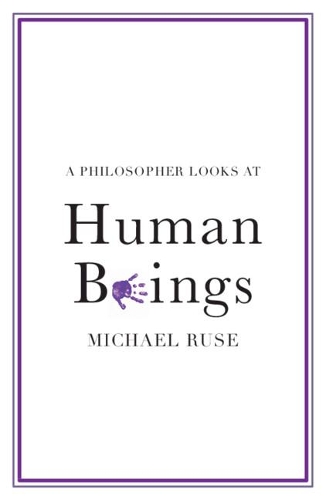
A Philosopher Looks at Human Beings - A Philosopher Looks At
paperback
Published:
20 May, 2021
paperback
Published:
20 May, 2021

Standard worldwide delivery by
Tue, July 7 - Fri, July 10
Order within
0

Condition:
USED
$10.07
RRP
$17.13
You save $7.05 (41%)
Available
1
in stock
FREE Returns within 30 days
Popular Books by Michael Ruse
View All Books by Michael Ruse
Description
Why do we think ourselves superior to all other animals? Are we right to think so? In this book, Michael Ruse explores these questions in religion, science and philosophy. Some people think that the world is an organism - and that humans, as its highest part, have a natural value (this view appeals particularly to people of religion). Others think that the world is a machine - and that we therefore have responsibility for making our own value judgements (including judgements about ourselves). Ruse provides a compelling analysis of these two rival views and the age-old conflict between them. In a wide-ranging and fascinating discussion, he draws on Darwinism and existentialism to argue that only the view that the world is a machine does justice to our humanity. This new series offers short and personal perspectives by expert thinkers on topics that we all encounter in our everyday lives.
More Details
| Type | Book |
|---|---|
| ISBN13 | 9781108820431 |
| ISBN10 | 1108820433 |
| Number Of Pages | 222 |
| Item Weight | 290 g |
| Product Dimensions | 131 x 197 x 20 mm |
| Publisher / Reseller | Cambridge University Press |
| Format | paperback |
See More +
GoodReads Reviews
Author's Bio
Michael Ruse is the former Lucyle T. Werkmeister Professor of Philosophy at Florida State University. Over his fifty-year career he has authored and co-edited over sixty books on topics ranging from the history and philosophy of science, especially evolutionary biology, to the philosophy of religion. They include Can a Darwinian be a Christian? (Cambridge, 2004), The Gaia Hypothesis: Science on a Pagan Planet (2013), and A Meaning to Life (2019).