Invitation to Linear Programming and Game Theory
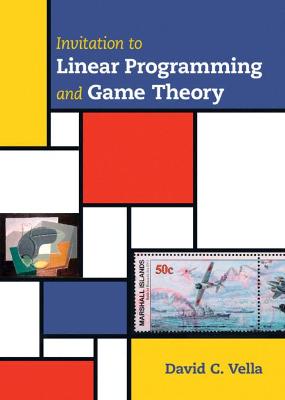
Invitation to Linear Programming and Game Theory
paperback
Published:
11 March, 2021

Popular Books by David C. Vella
View All Books by David C. Vella
Description
More Details
| Type | Book |
|---|---|
| ISBN13 | 9781108700023 |
| ISBN10 | 1108700020 |
| Number Of Pages | 542 |
| Item Weight | 919 g |
| Product Dimensions | 169 x 244 x 29 mm |
| Publisher / Reseller | Cambridge University Press |
| Format | paperback |
Media Reviews
'We all want to pull back the curtains for students, revealing a wider, more glorious mathematical universe beyond a mere list of rules for calculation. What content best introduces mathematics as the analysis of ideas that are both beautiful and essential to our understanding of the world? Everyone plays games whenever their goals contend against those of others, so our students already have experience with strategic reasoning. This helps Game Theory lower the abstraction barrier, making it an ideal context for a first course in mathematical reasoning. Vella's careful and thorough treatment uses clear language, in a conversational tone ideal for its intended audience: advanced high school students, along with first and second year undergraduates. What further distinguishes it from other texts is its parallel treatment of Linear Programming alongside Game Theory. This is a marriage made in heaven, with each topic serving the needs of the other.' William S. Zwicker, Union College
'This volume could be used to support coursework fulfilling math requirements offered for students with non-mathematics majors such as business or economics, or to supplement linear algebra courses. Recommended.' J. Parker, Choice
'This book is a scientific gift offered to the students by a genuine professor in linear mathematical programming and game theory, with proper applications.' Vasile Postolică, European Mathematical Society
Author's Bio
David C. Vella is Professor and Associate Chair of Mathematics at Skidmore College, New York. He has taught college mathematics for over thirty-five years, and has been an organizer of the Hudson River Undergraduate Mathematics Conference (HRUMC) since its inception in 1993. He is a member of the AMS, the MAA, and a charter member of the New York Alpha Theta chapter of Pi Mu Epsilon. His Erdős number is four.