The Path to Genocide in Rwanda :Security, Opportunity, and Authority in an Ethnocratic State - African Studies
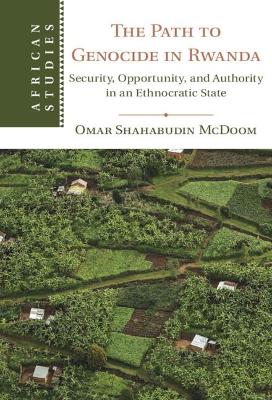
The Path to Genocide in Rwanda :Security, Opportunity, and Authority in an Ethnocratic State - African Studies
Hardback
Published:
11 March, 2021

Popular Books by Omar Shahabudin McDoom
View All Books by Omar Shahabudin McDoom
Description
More Details
| Type | Book |
|---|---|
| ISBN13 | 9781108491464 |
| ISBN10 | 1108491464 |
| Number Of Pages | 438 |
| Item Weight | 750 g |
| Product Dimensions | 235 x 160 x 30 mm |
| Publisher / Reseller | Cambridge University Press |
| Format | Hardback |
Media Reviews
'In this important and wide-reaching analysis, McDoom presents strong empirics - including new data and analysis at the local, regional, and national levels - to generate fresh insight into several key aspects of the Rwandan genocide … The framings and findings speak strongly to literatures on comparative violence and political mobilization, as well as to political science research on how context shapes political behavior and the political meaning of ethnicity.' Catherine Boone, London School of Economics and Political Science
'The product of a superb set of studies, carefully researched over the course of a decade and dispassionately analyzed. Most novel is McDoom's ability to reconstruct stories of what happened at the local level in a way that adds up to a coherent picture … He marries these close-ups to accounts of the politics at the regional and national level … The result is to produce a number of important new insights. Anyone serious about understanding the Rwanda genocide needs to read this book.' Stuart J. Kaufman, University of Delaware
'A fresh and wide-reaching analysis of the 1994 Genocide of the Tutsi in Rwanda. With a focus that ranges from the local to international levels and drawing on extensive original research, McDoom explores two key questions: Why did the genocide take place, and why did people participate? His argument will shape future discussions not only of the Rwandan case but of comparative genocide studies.' Timothy Longman, Boston University
'… provides fresh insights into some of the most troubling questions concerning the genocide that killed between 512,000 and 662,000 Tutsi, including how and why the genocide occurred, and why so many Rwandans participated in it. McDoom reflects on 25 years of scholarship and brings fresh insights gleaned from his new interview data.' Alex Vines, International Affairs
'an emotive, tragic, well-researched book … the book offers critical nuances on the Rwandan genocide grounded in empirical and theoretical interventions from a well experienced professor of political science … scholarly, engaging, and a significant contribution to comparative political science on conflicts, genocides, security studies, and more importantly adding knowledge beneficial to policy-makers, journalists, human rights advocates, historians, and the like-minded.' Brian Maregedze, African Studies Quarterly
'The book is dense with information and analysis that will greatly benefit genocide scholars, political scientists, and historians … It makes a significant contribution to the study of the Rwandan genocide, and libraries for advanced scholars should count it as an essential title for their collections. … Highly recommended.' C. Pinto, CHOICE
'Rich in historiography, empirics and insight, Path to Genocide is pivotal reading for scholars of Rwanda, mass violence and criminology. In discerning and articulating a scholarly consensus that is free from polemics, McDoom delivers the most up-to-date, meticulous and accessible itinerary into understanding the origins, rationales and dynamics that drove the Rwandan genocide.' Thijs B. Bouwknegt, African Affairs
'McDoom's major contribution lies in his use of data generated from field research in Rwanda, his application of theoretical lenses at the macro-, meso-, and micro-levels, and his careful interpretation of data that generates important nuance to his analysis. Herein lies the uniqueness and value of McDoom's The Path to Genocide in Rwanda.' Shadrack Wanjala Nasong'o, Political Science Quarterly
'The Path to Genocide in Rwanda is ground-breaking as the first book-length study on the Rwandan genocide to generate theoretical claims about the how and why of genocidal violence at the local, regional, and national levels.' Susan Thomson, Perspectives on Politics
'The Path to Genocide in Rwanda holds enormous value for scholars in the intersecting fields of social science and genocide studies. The book offers carefully researched conclusions highly specific to 1994 Rwanda and crucial in distinguishing that particular genocide from others.' Gerise Herndon, African Studies Review
Author's Bio
Omar Shahabudin McDoom is Assistant Professor of Comparative Politics in the Department of Government at the London School of Economics and Political Science. A political scientist and lawyer by training, he has been researching Rwanda's genocide since he first visited the country in 2003. He has previously held research fellowships at Harvard and Oxford universities and, prior to academia, he worked as a Policy Officer for the World Bank where his interest in the genocide originated.