Private Life and Privacy in Nazi Germany
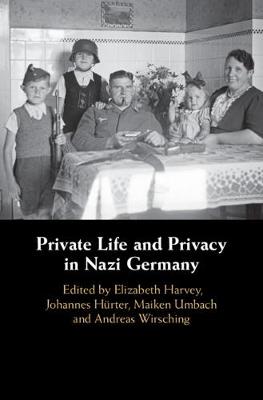
Private Life and Privacy in Nazi Germany
hardback
Published:
18 July, 2019

Popular Books by Elizabeth Harvey
View All Books by Elizabeth Harvey
Description
More Details
| Type | Book |
|---|---|
| ISBN13 | 9781108484985 |
| ISBN10 | 1108484980 |
| Number Of Pages | 410 |
| Item Weight | 800 g |
| Product Dimensions | 157 x 235 x 24 mm |
| Publisher / Reseller | Cambridge University Press |
| Format | hardback |
Media Reviews
'An extraordinary, inquisitive, immersing exploration of lives lived in the Third Reich, where the grit of detail and sharpness of insight exposes an entire century that stumbled in war and peace. You will be well-guided by the eloquence of the contributors and unsettled by their conclusions.' Peter Fritzsche, University of Illinois and author of An Iron Wind
'This volume looks at the Third Reich from a fresh and productive angle. A range of excellent chapters show that privacy was by no means absent from the supposedly 'collectivistic' dictatorship. Rather, it was reinterpreted, granted and denied in peculiar ways.' Moritz Föllmer, Universiteit van Amsterdam
'The contributors to this volume deepen and refine our understanding of the boundaries of the private sphere in a society suffused by propaganda and subjected to continual attempts at political mobilization. These important essays show us how millions of ordinary Germans experienced daily life in the Third Reich.' Alan E. Steinweis, University of Vermont
'The essays in this splendid volume, all fresh, readable and authoritative, remind us why the question 'What happened to the private sphere in Nazi Germany?' is important and offer persuasive approaches to answering it.' Eve Rosenhaft, University of Liverpool
'… the volume's combination of new empirical research and theoretical sophistication is impressive, representing an important point of departure for anyone interested in the private and privacy in the Third Reich.' Eric Kurlander, European History Quarterly
Author's Bio
Elizabeth Harvey is Professor of History at the University of Nottingham. She has published extensively on Weimar and Nazi Germany, particularly on gender history, the history of youth and the history of photography. She is the author of Women and the Nazi East: Agents and Witnesses of Germanization (2003) and is currently working on the history of gender and forced labour in occupied Poland. Johannes Hürter is Head of the Research Department Munich at the Institut für Zeitgeschichte, Munich and Adjunct Professor of Modern History at the Leibniz Institute for Contemporary History Munich-Berlin. He is a leading expert on the political and military history of Weimar Germany and the Third Reich. His works include Hitlers Heerführer: Die deutschen Oberbefehlshaber im Krieg gegen die Sowjetunion 1941/42 (2006) and Hitler: New Research (edited with Elizabeth Harvey, 2018). Maiken Umbach is Professor of Modern History at the University of Nottingham. She is co-director of Nottingham's Centre for the Study of Political Ideologies, and Principal Investigator of the AHRC-funded project 'Photography as Political Practice in National Socialism'. She has published extensively on the relationship between subjectivity, identity politics, and ideology in modern European history. Her works include Authenticity: The Cultural History of a Political Concept (2018) and Photography, Migration and Identity: A German-Jewish-American Story (2018). Andreas Wirsching is Director of the Institut für Zeitgeschichte, Munich and Professor of History at the Leibniz Institute for Contemporary History Munich-Berlin. He has published extensively on European political history in the nineteenth and twentieth centuries and the history of the European Union. His most recent works include Hüter der Ordnung: Die Innenministerien in Bonn und Ost-Berlin nach dem Nationalsozialismus (edited with Frank Bösch, 2018).