Minilateralism :How Trade Alliances, Soft Law and Financial Engineering are Redefining Economic Statecraft
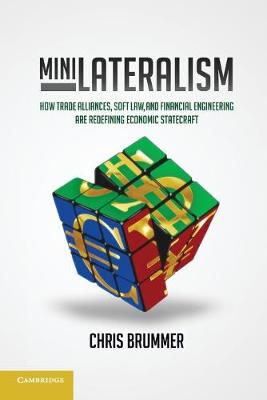
Minilateralism :How Trade Alliances, Soft Law and Financial Engineering are Redefining Economic Statecraft
paperback
Published:
7 April, 2014

Popular Books by Chris Brummer
View All Books by Chris Brummer

Description
More Details
| Type | Book |
|---|---|
| ISBN13 | 9781107678569 |
| ISBN10 | 1107678560 |
| Number Of Pages | 224 |
| Item Weight | 380 g |
| Product Dimensions | 152 x 227 x 14 mm |
| Publisher / Reseller | Cambridge University Press |
| Format | paperback |
Media Reviews
'Chris Brummer's core message is that multilateralism is giving way to minilateralism. As the era of American hegemony draws to a close and as the institutions that once dominated the multilateral era (the WTO, the World Bank and the IMF) find themselves constrained by a more complex environment, new institutions and smaller networks are developing, much as the first small, furry mammals quietly appeared at the end of the Age of Dinosaurs. Brummer incisively connects the dots between financial, trade and monetary regulation, charting the growth of these new bodies … This is an eye-opening and elegantly written tour, as history and economics interact, new institutions evolve, and soft law seeks to hold the new networks together.' John C. Coffee, Jr, Adolf A. Berle Professor of Law and Director, Center on Corporate Governance, Columbia Law School
'Chris Brummer has brought several seemingly disparate trends in the global financial system together under the useful umbrella of minilateralism. In doing so, his lively and engaging writing style gives life to the details of global governance and financial engineering. Most importantly, however, instead of just celebrating the new status quo, he identifies minilateralism as a response to globalization that when improperly managed can create as many problems as it solves.' Anne-Marie Slaughter, President and CEO, New America; and Bert G. Kerstetter '66 University Professor of Politics and International Affairs, Princeton University
'Professor Brummer ably captures the recent evolution from standard-setting and consensus building via large, multilateral institutions promoting universalist principles, to norms established via smaller coalitions focused on addressing the particularist needs of like-minded partners. Few books tackle so many topics so clearly and elegantly, and bundle them into one compelling narrative. Moving from the regulation of coins in medieval Europe to today's international money supply and the rise of the Chinese RMB, and from Venetian trade strategy to today's WTO, Minilateralism offers a compelling history and theory of how economic diplomacy works. For standard-setters looking to understand their role in the global economy, a must read from a top expert in the field.' Ethiopis Tafara, Vice President and General Counsel, International Finance Corporation, World Bank Group
Author's Bio
Chris Brummer is Professor at Georgetown University Law Center, C. Boyden Gray Fellow on Growth and Finance at the Atlantic Council, and Senior Fellow at the Milken Institute. Professor Brummer lectures widely on finance and global governance, and has taught or visited at the University of Basel, the University of Heidelberg, the London School of Economics and Political Science, and Vanderbilt University. He is the author of Soft Law and the Global Financial System (2012).