Domestic Law Goes Global :Legal Traditions and International Courts
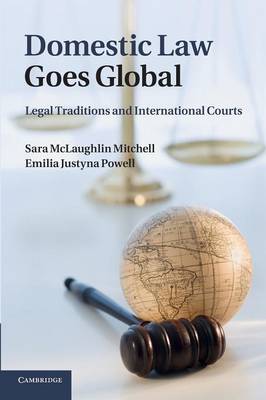
Domestic Law Goes Global :Legal Traditions and International Courts
paperback
Published:
5 December, 2013

Popular Books by Sara McLaughlin Mitchell
View All Books by Sara McLaughlin Mitchell



Description
More Details
| Type | Book |
|---|---|
| ISBN13 | 9781107661677 |
| ISBN10 | 1107661676 |
| Number Of Pages | 278 |
| Item Weight | 380 g |
| Product Dimensions | 152 x 229 x 15 mm |
| Publisher / Reseller | Cambridge University Press |
| Format | paperback |
Media Reviews
'This book is one of the few concrete manifestations of the multiple calls to marry social science methods and international relations scholarship with international legal study. Rather than philosophical analysis or normative statements, the authors provide causal arguments and back them up with systematic empirical evidence - a real advance in the field.' Paul F. Diehl, Henning Larsen Professor of Political Science, University of Illinois
'Mitchell and Powell make a major contribution by showing how current international law and international relations reflect the complex interactions of three different legal traditions. Equally important, they generate a sophisticated theory and analysis of the differences between the incentives, opportunities, and behaviors of the states that create international institutions and those that join those institutions after they are created. This work is important reading for scholars of both international law and international relations.' Ronald B. Mitchell, University of Oregon
'This is an exciting and original contribution to understanding ways that domestic politics and institutions influence international relations. Using lay language but rigorous methods, Mitchell and Powell show that states struggle to influence international legal institutions to reflect their own legal traditions. These scholars point out that modelling international courts on domestic legal systems serves to reduce the perceived uncertainty states face when they delegate adjudicative powers to such courts. Theirs is a new and powerful argument, and it will stimulate valuable debate about why it is that states prefer to create and join international institutions in their own image.' Beth A. Simmons, Clarence Dillon Professor of International Affairs, Harvard University
Author's Bio
Sara McLaughlin Mitchell is Professor of Political Science and Department Chair at the University of Iowa. Emilia Justyna Powell is Assistant Professor in the Department of Political Science at the University of Alabama.