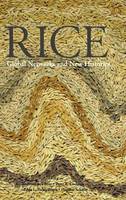
Rice :Global Networks and New Histories
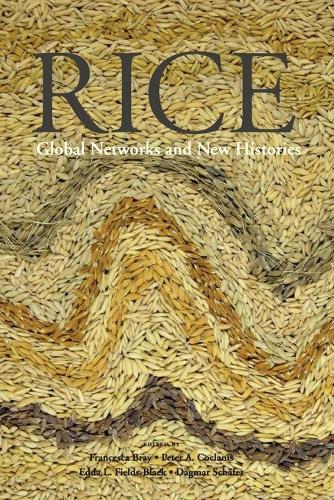
Rice :Global Networks and New Histories
paperback
Published:
25 May, 2017

Popular Books by Francesca Bray
View All Books by Francesca Bray
Description
More Details
| Type | Book |
|---|---|
| ISBN13 | 9781107622371 |
| ISBN10 | 1107622379 |
| Number Of Pages | 446 |
| Item Weight | 680 g |
| Product Dimensions | 153 x 230 x 28 mm |
| Publisher / Reseller | Cambridge University Press |
| Format | paperback |
Media Reviews
'To see the world in a grain of rice! Beyond mere matters of taste, rice is possibly the world's most important food crop. Its cultivation and consumption have affected vast areas of Asia, Africa, and the Americas, not to mention the billions who rely on it as their principal dietary staple. We reflexively think of rice as the food of Asia par excellence, but since the voyages of Columbus, the African contributions - with an ancient and independently domesticated rice species - have played no small part in the history of the Americas. This is a story of globalization: rice's geographical reach is worldwide, its histories complex and deep. Now, Rice: Global Networks and New Histories brings together scholarship that recovers in one peerless volume the modern history of a truly global crop.' Judith Carney, University of California, Los Angeles
'The editors of this volume have gathered expert voices from across the spectrum of study, and together they have painted a dynamic portrait of the world's most important food. In so doing, they have shown us once again that rice is more than just rice. It is a powerful force that shapes societies and landscapes, a tool wielded across centuries and on every agricultural continent. Even as some of this book's histories reach into the deep past, their words are sharply relevant to the questions of food production and culture in the twenty-first century.' Lisa M. Hamilton, author of Deeply Rooted: Unconventional Farmers in the Age of Agribusiness
'A stunningly sophisticated and comprehensive examination of the worldwide peregrinations of rice - its genes, its growers, its merchants, its consumers, and its cultural effects. As a model, or arguably the world's most important staple - both materially and symbolically - wheat and maize can only dream of a day when they too will have a volume that does them such justice.' James C. Scott, Co-Director, Program in Agrarian Studies, Yale University
'Reflecting a good balance of experts on rice production and consumption, the contributors incorporate innovative approaches and collaborations in their research, considering, for example, plant genetics, paleohydrology, and historical linguistics. Of benefit not only to those interested in environmental and economic history, this comprehensive book provides another tool for those making policy decisions around food security and sustainable development through its illumination of the social, environmental, and economic history of this vital grain. Summing up: essential.' E. G. Harrington, Choice
'This substantial and informative work aims to construct and articulate a nuanced appreciation of rice, as traded commodity or local staple, connected across its diverse geophysical, ecological and human settings … I recommend the work to all who are practically concerned with rice or food security … It is often said that one cannot claim to be seriously engaged with a crop until one has woken up from dreaming that one was re-embodied as a crop plant in the ground. This book will provide much material to invigorate, contextualize and add vivid colour to such dreams.' Food Security
'Rice features a dazzling variety of methodologies and employs them in an eclectic collection of case studies. Different essays consider quantitative correlations, compare DNA structures from different strains of rice, and make use of historical linguistics, in a truly interdisciplinary collection that includes the work of historians, anthropologists, agricultural scientists, historians of science, and area studies scholars.' Agricultural History
GoodReads Reviews
Author's Bio
Francesca Bray is Professor of Social Anthropology at the University of Edinburgh. She is the author of The Rice Economies: Technology and Development in Asian Societies (1994), Technology and Gender: Fabrics of Power in Late Imperial China (1997), Technology and Society in Ming China, 1368-1644 (2000), and Technology, Gender and History in Imperial China: Great Transformations Reconsidered (2013). Peter A. Coclanis is Albert R. Newsome Distinguished Professor of History and director of the Global Research Institute at the University of North Carolina, Chapel Hill. He is the author of The Shadow of a Dream: Economic Life and Death in the South Carolina Low Country, 1670-1920 (1989) and Time's Arrow, Time's Cycle: Globalization in South East Asia over la Longue Durée (2006), and the co-editor of Environmental Change and Agricultural Sustainability in the Mekong Delta (with Mart A. Stewart, 2011). Edda L. Fields-Black is Associate Professor of History at Carnegie Mellon University, Pennsylvania. She is the author of Deep Roots: Rice Farmers in West Africa and the African Diaspora (2008). Dagmar Schaefer is director of the Centre for Chinese Studies and Professor of Chinese Studies at the University of Manchester. She is the author of The Emperor's Silk Clothes: State-Run Silk Manufacturing in the Ming Period, 1368-1644 (1998) and The Crafting of the 10,000 Things: Knowledge and Technology in 17th-Century China (2011), and the co-author of Weaving an Economic Pattern in Ming Times, 1368-1644 (with Dieter Kuhn, 2002).