Hume and the Politics of Enlightenment
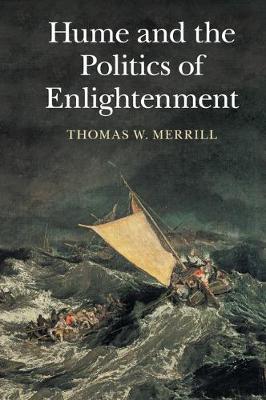
Hume and the Politics of Enlightenment
paperback
Published:
29 March, 2018

Popular Books by Thomas W. Merrill
View All Books by Thomas W. Merrill





Description
More Details
| Type | Book |
|---|---|
| ISBN13 | 9781107519657 |
| ISBN10 | 1107519659 |
| Number Of Pages | 212 |
| Item Weight | 340 g |
| Product Dimensions | 153 x 230 x 14 mm |
| Publisher / Reseller | Cambridge University Press |
| Format | paperback |
Media Reviews
'A political view of Hume's philosophy and a philosophical view of his politics, nicely combined. Thomas W. Merrill's fine interpretation centers on Hume's revealing early works and finds in them more Socrates than Newton, a scientific skepticism that doubts science, and a prudent deference to political opinion.' Harvey C. Mansfield, Professor of Government, Harvard University, Massachusetts and Senior Fellow, Hoover Institution
'Merrill has written a book that should have been written long ago. For all the studies of Hume's thought, no one has so intelligently and persuasively shown how Hume's radical philosophic questioning is connected to his moral and political thought. Merrill not only offers a provocative new reading of the Treatise but also shows how Hume's ambition to develop a new science of human nature on the bedrock of skepticism leads to a reformist political project in the often neglected Essays. Indeed, whereas most scholars ignore Hume's Essays or discuss them piecemeal, one of the main contributions of Merrill's book is to show the unity of the Essays and to trace how Hume's political project develops over the course of the work as a whole. I learned something new on almost every page of this important study.' John T. Scott, University of California, Davis
'In this provocative and persuasive study, Thomas W. Merrill treats the career and the thinking of David Hume as no one has before, drawing out in full the implications of a remark, made in the Treatise of Human Nature, in which the Scot compares his project as a philosopher with that of Socrates as represented by Cicero in the Tusculan Disputations; and showing in fine detail that what appears to be a passing remark is, in fact, the key to Hume's entire enterprise. To be more precise, he demonstrates that Hume's turn from metaphysical materialism to a treatment of the science of human nature as first philosophy recapitulates Socrates' rejection of the approach of Anaxagoras and his 'second sailing' as described in the Phaedo.' Paul Rahe, Hillsdale College, Michigan
'This book portrays a Hume of precipices and paradoxes: a fearless skeptic devoted to the theory and practice of political moderation and the broker of an innovative, unlikely alliance between modern philosophers and a prudent middle class, in support of commerce and the rule of law. While it will not convince everyone and will start a debate rather than ending it, this highly original, forcefully written, ingenious, and insightful book ranks immediately among the indispensable works on Hume's political thought. It establishes Merrill not only as one of the brightest Hume scholars of his generation but as a striking new voice in political theory.' Andrew Sabl, Yale University, Connecticut
GoodReads Reviews
Author's Bio
Thomas W. Merrill is a political theorist in the School of Public Affairs at American University in Washington, DC. He was a senior research analyst at the President's Council on Bioethics and is the co-editor of Apples of Gold in Pictures of Silver: Honoring the Work of Leon R. Kass (with Yuval Levin and Adam Schulman, 2010) and Human Dignity and Bioethics (with Edmind D. Pellegrino and Adam Schulman, 2009). He has held fellowships from Princeton University, New Jersey, Harvard University, Massachusetts, and the American Enterprise Institute, Washington, DC.