Making News in Global India :Media, Publics, Politics
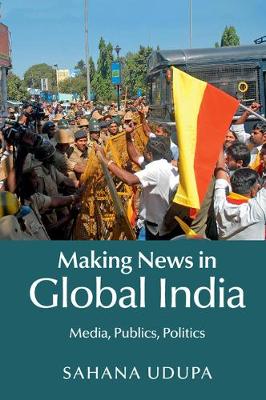
Making News in Global India :Media, Publics, Politics
paperback
Published:
8 February, 2018

Popular Books by Sahana Udupa
View All Books by Sahana Udupa

Description
More Details
| Type | Book |
|---|---|
| ISBN13 | 9781107492134 |
| ISBN10 | 1107492130 |
| Number Of Pages | 292 |
| Item Weight | 450 g |
| Product Dimensions | 153 x 230 x 15 mm |
| Publisher / Reseller | Cambridge University Press |
| Format | paperback |
Media Reviews
'Sahana Udupa's Making News in Global India ranks among the most important theoretical and ethnographic studies of news media in South Asia to be published in recent years. She argues convincingly that our assumptions about publicity and privacy, vernacular and standard, local and global need to be rethought in order to fully understand the operations of news media in India's 'world-class' cities.' Dominic Boyer, Rice University, Houston
'Sahana Udupa has written a groundbreaking, lively, and important media ethnography exploring the worlds of print journalists and journalism in Bangalore, showing how their work is inseparable from India's rapid urbanization, and transforming logics of region, caste, class and language.' Faye Ginsburg, New York University
'Sahana Udupa's lively and perceptive ethnography of English and Kannada news production in Bangalore goes beyond the usual antitheses of local and global to show the emergence of new pathways of social change, and new sites and styles of cultural resistance. An important contribution to the literature on the contemporary dynamics of cultural globalization in India.' Arvind Rajagopal, New York University
'What role does Bangalore's private news culture play in shaping the southern Indian metropolis' ongoing urban transformation? Sahana Udupa's new book answers this question through a fascinating and fine grained ethnography of the city's bilingual news media. Exploring differences amongst the English language and local language press, class-based civic activism, novelties in newsroom practices and layers of journalistic identities, the book shows the ways in which a certain type of aspiration that has come to characterize some news outlets, conflicts and contends with the visibility of local urban cultures and the struggle for dominance amongst different actors in the news field.' Ian Cook, New Books Network (newbooksnetwork.com)
'As an exemplar of a riveting ethnographic enquiry about a city's transformed newspaper scene and its conflicted and collaborative relationships with modernity, Udupa's book stands alongside other similarly engrossing accounts of the fascinating complexity of the Indian newspaper landscape. The book adds to an increasing field of knowledge that has sought to theorize the Indian media by building upon preexisting conceptual tools and adding new ones to them. In doing so, Making News in Global India opens up key new avenues for scholars similarly interested in capturing the cultural, political, and historical vectors that make the Indian media scene unique.' Sangeet Kumar, Communication, Culture and Critique
'It is on rare occasions that one comes across a study that is both theoretically sophisticated and deeply grounded in the localities of news production … the study offers a compelling perspective on the ways in which news production is being shaped not just by the variegated compulsions of globalising India but also by the force of changing tradition, national politics, flows of ideas within news rooms and personnel within a highly competitive news environment.' Pradip Ninan Thomas, Media International Australia
'Udupa does a commendable job of weaving together the politics of the social locations of the journalists with their work culture.' Sudeshna Devi, International Social Science Review
'This nuanced and well-argued book has the added advantage of straddling English and vernacular worlds, allowing Udupa to intervene significantly in how we understand the dynamics of interaction between the language of empire and globalisation and the realm the author terms 'bhasha' media. … This book must be read not only by all of those interested in the continuing importance of printed news in a world increasingly defined by digitalisation, but also by anyone concerned with the future of cities as zones of public discourse and conflict. As part of a broader shift in anthropology to consider mass mediation beyond reductionist accounts of technical networks, Udupa's book has also made a significant contribution to our understanding of globalising cities and the political public sphere itself.' Francis Cody, Contributions to Indian Sociology
'In this book, Sahana Udupa develops a rich and complex analysis of the news media of Bangalore in the context of urban neo-liberal transformation. … her impressive ethnography reaches beyond media anthropology to inform recent scholarly interest in the spaces and discourses of post-colonial cities …' Jennifer Hasty, South Asia: Journal of South Asian Studies
'… the topic is engrossing, the interviews are full of insights, and the author's industry is unquestionable. The book adds another perspective on Bengaluru, India's most switched-on city, and how its swelling numbers of citizens relate to the media by which they connect to their world.' Robin Jeffrey, Asian Studies Review
Author's Bio
Sahana Udupa is a Research Fellow at the Max Planck Institute for the Study of Religious and Ethnic Diversity, Goettingen, Germany. Her research interests have evolved around anthropological explorations of news media, global urbanization, social media, and transnational religious politics. She has been awarded fellowships and grants by the Annenberg School of Communication (University of Pennsylvania), the Max Planck Society (Germany), and the National Institute of Advanced Studies (India). Her research is published in premier academic journals including American Ethnologist and Media, Culture and Society. She is actively involved in international academic collaborations across India, Europe and North America. She carries with her several years of experience working as a bilingual journalist in India, and her enduring relations with the journalistic community.