Law’s History :American Legal Thought and the Transatlantic Turn to History - Cambridge Historical Studies in American Law and Society
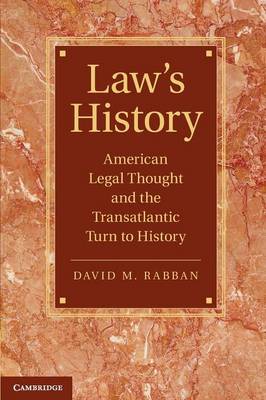
Law’s History :American Legal Thought and the Transatlantic Turn to History - Cambridge Historical Studies in American Law and Society
paperback
Published:
10 July, 2014

Popular Books by David M. Rabban
View All Books by David M. Rabban


Description
More Details
| Type | Book |
|---|---|
| ISBN13 | 9781107425088 |
| ISBN10 | 1107425085 |
| Number Of Pages | 582 |
| Item Weight | 880 g |
| Product Dimensions | 156 x 234 x 33 mm |
| Publisher / Reseller | Cambridge University Press |
| Format | paperback |
Media Reviews
'This is a pioneering study of American historical jurisprudence in the late nineteenth century. It is comprehensive, meticulous, and deeply learned. It is cosmopolitan, placing the Americans among their European predecessors and counterparts. And it is eye-opening: the standard picture of this era's legal scholars as political reactionaries and abstract deductive 'formalists' cannot possibly survive this splendid and important book.' Robert W. Gordon, Stanford Law School
'This accomplished work of intellectual legal history is the first complete account of American legal thought from the rise of Classical Legal Thought in the 1870s to the Sociological Jurisprudence of the pre-World War I era. Though it offers many illuminating challenges to conventional wisdom in the field, the book's first goal is to overthrow the still dominant Holmesian picture of Classical American legal thinkers as unhistorical prisoners of logic. Rabban shows instead the pervasive influence of historical consciousness on leading American legal thinkers, many of them influenced by Darwinian evolutionary ideas.' Morton Horwitz, Charles Warren Professor of American Legal History, Harvard Law School
'Law's History is an important analysis of the historical mentality of late-nineteenth-century legal scholarship and a revealing guide to ways twentieth-century scholars have interpreted it.' Dorothy Ross, The Johns Hopkins University
'A remarkable book. Rabban amply documents the 'Atlantic crossings' in legal scholarship at the turn of the twentieth century and unpacks the deep connections between history and law in modern American and continental legal thought. Essential reading for those interested in the intellectual history of law.' Keith E. Whittington, Princeton University
'Law's History is a comprehensive and illuminating study of early American legal scholarship.' Harvard Law Review
'David Rabban's stated goal in Law's History is to reconstruct our account of nineteenth-century legal history in America. He has done so in a meticulous and impressive fashion … [This book] is an intriguing blend of legal history and intellectual history … ambitious and provocative. Not only has Rabban provided us with a more balanced view of our nineteenth-century predecessors, but also of their successors and ultimately ourselves.' Law and Politics Book Review
'This excellent study reveals the extent to which our heritage of legal thought is much more than a narrow argument about forms and rules. It is an integral part of a cultural history arising out of intellectual enquiries which were both broad and deep. The enquiries were as remarkable as the work of the twentieth-century studies which often concealed the notable achievements of the nineteenth-century scholars. The modern legal historian can enjoy the restoration of an enlightened era of intellectual adventure whilst at the same time pausing for thought at the extent to which this was distorted by a later generation.' Journal of Legal History
'Rabban's landmark book makes an essential contribution by providing us with a new geography as well as excavating legal history's neglected past.' Law and History Review
Author's Bio
David M. Rabban is Dahr Jamail, Randall Hage Jamail and Robert Lee Jamail Regents Chair in Law and University Distinguished Teaching Professor at the University of Texas School of Law. Rabban is the author of Free Speech in Its Forgotten Years (Cambridge University Press, 1997), which won the 1998 Morris D. Forkosch Prize presented by the Journal of the History of Ideas and the 1998 Eli M. Oboler Award of the American Library Association Intellectual Freedom Roundtable.