String Theory Methods for Condensed Matter Physics
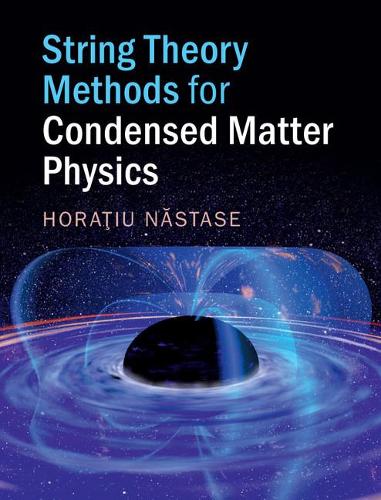
String Theory Methods for Condensed Matter Physics
hardback
Published:
21 September, 2017

Popular Books by Horatiu Nastase
View All Books by Horatiu Nastase
Description
More Details
| Type | Book |
|---|---|
| ISBN13 | 9781107180383 |
| ISBN10 | 1107180384 |
| Number Of Pages | 628 |
| Item Weight | 1520 g |
| Product Dimensions | 193 x 253 x 30 mm |
| Publisher / Reseller | Cambridge University Press |
| Format | hardback |
Media Reviews
'This book is an excellent reference for students willing to bridge the gap between condensed matter physics and gravity by using holography.' Juan Maldacena, Institute for Advanced Study, New Jersey
'A nice survey of holographic techniques applied to condensed matter systems. It should provide a smooth entryway to novices desiring to work in this fascinating field.' Diego Trancanelli, Universidade de São Paulo
'In this, his second book on applied string theory, Nastase gives a wonderfully telescopic account of one of the most exhilarating developments in the field: holographic condensed matter. In 48 chapters, he takes the reader from the very basics of condensed matter and string theory right up to the very latest progress. With a number of well-constructed exercises in addition to detailed computations, it has a little bit for everyone from graduate students of both high energy and condensed matter physics to seasoned researchers looking to expand their horizons.' Jeff Murugan, University of Cape Town
'The gauge/gravity duality, which arose from studies in string theory in the late 1990s, is one of the most important modern tools to understand the behavior of quantum field theories at strong coupling. This book builds a bridge between the physics of condensed matter systems and the string theory ideas that can be used to understand them better. The book will be very useful both for students of condensed matter physics that want to apply the gauge/gravity duality to their field as well as for string theory students who want to understand better the connections between string theory and condensed matter systems.' David Berenstein, University of California
'In this ambitious advanced textbook, Horaţiu Năstase, a member of the Institute for Theoretical Physics at the State University of São Paulo, Brazil, aims to introduce graduate students and researchers to the application of string theory to condensed-matter physics. String Theory Methods for Condensed Matter Physics assumes previous graduate coursework in quantum field theory and some knowledge of solid-state physics and general relativity. However, Năstase writes that he intends for the book to be accessible to readers who are just beginning to learn about string theory and its relation to condensed matter. Each chapter includes exercises and a summary of important concepts.' Melinda Baldwin, Physics Today
Author's Bio
Horatiu Nastase is a Researcher at the Institute for Theoretical Physics at the Universidade Estadual Paulista, São Paulo. To date, his career has spanned four continents. As an undergraduate he studied at Universitatea din București, Romania and University of Copenhagen. He later completed his Ph.D. at the State University of New York, Stony Brook, before moving to the Institute for Advanced Study, Princeton, where his collaboration with David Berenstein and Juan Maldacena defined the pp-wave correspondence. He has also held research and teaching positions at Brown University and the Tokyo Institute of Technology.