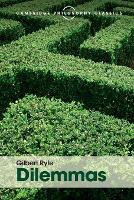
Dilemmas :The Tarner Lectures 1953 - Cambridge Philosophy Classics

Dilemmas :The Tarner Lectures 1953 - Cambridge Philosophy Classics
hardback
Published:
15 October, 2015

Popular Books by Gilbert Ryle
View All Books by Gilbert Ryle
Description
More Details
| Type | Book |
|---|---|
| ISBN13 | 9781107113626 |
| ISBN10 | 1107113628 |
| Number Of Pages | 120 |
| Item Weight | 310 g |
| Product Dimensions | 159 x 235 x 11 mm |
| Publisher / Reseller | Cambridge University Press |
| Format | hardback |
Media Reviews
'The great merit of this book is that it grasps philosophical problems at that critical stage when they are just casting off their connexions with everyday life, just about to launch on their long academic flight, and that it attempts to deal with them then and there, before they can become airborne. Brisk, homely and almost practical, it really challenges everyone to try to be his own philosopher … the peculiar, penetrating simplicity of this kind of philosophy is exceedingly hard to achieve.' The Times Literary Supplement
Author's Bio
Gilbert Ryle (1900-76) published widely on a variety of philosophical topics, including philosophy of mind and philosophy of language, but was perhaps best known for his work on philosophical behaviourism and his critique of Cartesian dualism.