
3.43Kg of CO2

429 litre(s) of Water

0.0257 Tree(s)

1 book donated to global literacy projects
The Cambridge Handbook of Bilingual Processing - Cambridge Handbooks in Language and Linguistics
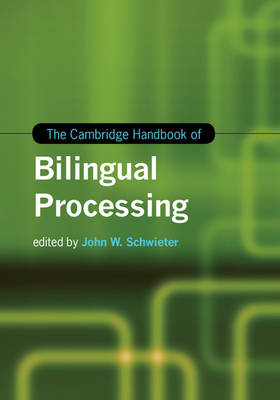
The Cambridge Handbook of Bilingual Processing - Cambridge Handbooks in Language and Linguistics
hardback
Published:
6 August, 2015


Popular Books by John W. Schwieter
View All Books by John W. Schwieter
Description
More Details
| Type | Book |
|---|---|
| ISBN13 | 9781107060586 |
| ISBN10 | 1107060583 |
| Number Of Pages | 858 |
| Item Weight | 1820 g |
| Product Dimensions | 181 x 253 x 43 mm |
| Publisher / Reseller | Cambridge University Press |
| Format | hardback |
Media Reviews
'The editor has brought together an excellent group of scholars who provide a comprehensive state-of-the-art overview on topics inherent to bilingual language processing. In the coming years, this volume will surely become the reference book for researchers and students working in the field of bilingualism.' Jubin Abutalebi, Università Vita-Salute San Raffaele
'A handbook to take with you on your intellectual journeys! It provides a detailed map of the dynamic world of multilingualism and is indispensable to both first-time visitors and long-time explorers. The multifaceted landscape of language learning and use is portrayed from a multidisciplinary perspective by means of established and innovative models, methodologies, and findings in the field.' Ton Dijkstra, Radboud University Nijmegen
'The study of bilingualism has seen a virtual explosion over the past twenty years with increasing interest both in bilingualism itself as a topic of study and in how bilinguals provide a unique form of evidence which will contribute to long-standing debates in the cognitive sciences. This comprehensive volume of papers touches on all the major points of special interest including bilinguals of all ages, proficiency levels, and acquisition histories, as well as the various methodologies applied and theoretical debates within the field. Each of these points of focus is reviewed in this volume by key voices in the field culminating in a volume of work that will be useful for students and researchers alike, and one that should quickly gain status as a reference and guide to the latest and greatest in research on bilingualism as well as its broader implications.' Tamar Gollan, University of California, San Diego
'This exciting volume presents a set of cutting-edge overviews of the complex field of bilingual processing, covering a range of theoretical and methodological topics. A must-read for anyone interested in the nature of bilingualism.' Marianne Gullberg, Lund University
'This volume provides a well-structured and comprehensive overview of current theoretical perspectives and empirical findings regarding the representation- and processing-related mechanisms involved in second language acquisition and the tasks of becoming and being bilingual. The chapters cover nearly all subsystems of language, deal with both comprehension and production, and address important issues such as attrition, cross-linguistic influence, the cognitive consequences of bilingualism, and the effects of multilingualism on language processing. This is an excellent resource for anyone who works in this area.' Scott Jarvis, Ohio University
'Both new and seasoned researchers will find this handbook truly indispensable. The line-up of contributors is outstanding, the range of topics vast, and the treatment more than introductory, providing comprehensive historical background and bold discussion of contemporary and controversial issues. Definitely a must-have reference source.' Norman Segalowitz, Concordia University
'How can we control the use of multiple languages without massive confusion? Addressing this question forces us to explore an entirely new conceptualization of the human mind. This excellent handbook provides us with an invitation to this exploration by synthesizing core facts about non-selective access, early bilingual separation, transfer, interference, control processes, cues for code-switching, meaning merger, learning dynamics, and emotional grounding. Each of these topics is explored with careful attention to the use of converging methodologies to increase the precision of our models.' Brian MacWhinney, Carnegie Mellon University
Author's Bio
John W. Schwieter is an Associate Professor of Spanish and Linguistics, and Faculty of Arts Teaching Scholar, at Wilfrid Laurier University in Waterloo, Ontario, where he is also the director of the Psycholinguistics and Language Acquisition Laboratory. He is also a Visiting Professor of Applied Linguistics in the Centre for Applied Research and Outreach in Language Education at the University of Greenwich, London.