Channelling Mobilities :Migration and Globalisation in the Suez Canal Region and Beyond, 1869–1914
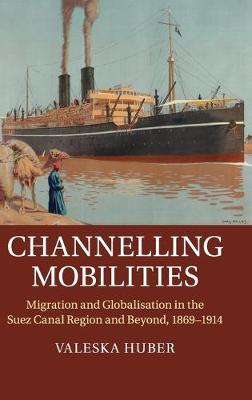
Channelling Mobilities :Migration and Globalisation in the Suez Canal Region and Beyond, 1869–1914
hardback
Published:
1 August, 2013

Popular Books by Valeska Huber
View All Books by Valeska Huber
Description
More Details
| Type | Book |
|---|---|
| ISBN13 | 9781107030602 |
| ISBN10 | 1107030609 |
| Number Of Pages | 365 |
| Item Weight | 680 g |
| Product Dimensions | 157 x 235 x 26 mm |
| Publisher / Reseller | Cambridge University Press |
| Format | hardback |
Media Reviews
'Valeska Huber's richly detailed study of the Suez canal confounds a view of history as ever-increasing connections across space. She shows that the canal was a choke point as well as a connector, a 'decelerator' as much as an 'accelerator' of movement, and a site where governing elites sought to control migration and to elaborate and enforce distinctions among people, not simply to facilitate their mobility and interaction.' Frederick Cooper, co-author of Empires in World History: Power and the Politics of Difference
'A sophisticated examination of a variety of global connections and systems of control as they impacted the peoples affected by the opening of the Suez Canal. This invaluable contribution to the growing literature on nineteenth-century globalization provides a marvelous model for the study of the interaction of the global and the local everywhere.' E. Roger Owen, author of State, Power and Politics in the Making of the Modern Middle East
'This is a fascinating book. The opening of the Suez Canal in 1869 typically serves as a short-hand for the dynamic processes of transportation, communication, and globalization in the nineteenth century. As Valeska Huber vividly shows, the story was much more complex. Multiple forms of mobility overlapped in the Canal region; some were accelerated, others slowed down. We learn of steamships and long-distance travel, of military strategies and global trade - but also of camel caravans and Bedouins, of passports and pilgrims to Mecca. This superbly researched book demonstrates that the best global histories are grounded locally.' Sebastian Conrad, author of German Colonialism: A Short Introduction
'Channelling Mobilities takes up a host of binaries related to historical and analytical values and puts them under rigorous historical examination. The result, which is a highly readable and thought-provoking book, is therefore majorly recommended for historians working on late nineteenth- and early twentieth-century 'imperial' and/or 'global' history.' Nitin Sinha, The International Journal of Maritime History
Author's Bio
Valeska Huber is a Research Associate at the German Historical Institute in London.