Descriptive Complexity, Canonisation, and Definable Graph Structure Theory - Lecture Notes in Logic
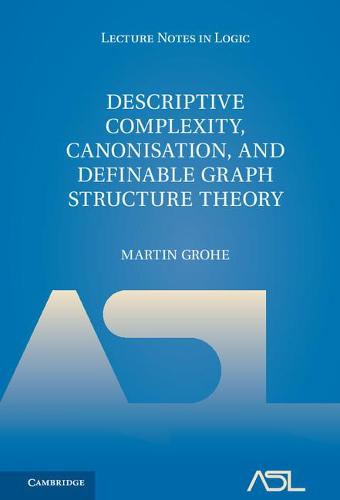
Descriptive Complexity, Canonisation, and Definable Graph Structure Theory - Lecture Notes in Logic
hardback
Published:
17 August, 2017
hardback
Published:
17 August, 2017

Standard worldwide delivery by
Thu, August 6 - Tue, August 11
Order within
0
Condition:
NEW
$208.39
RRP
$214.32
You save $5.92 (3%)
Available
1
in stock
FREE Returns within 30 days
Popular Books by Martin Grohe
View All Books by Martin Grohe
Description
Descriptive complexity theory establishes a connection between the computational complexity of algorithmic problems (the computational resources required to solve the problems) and their descriptive complexity (the language resources required to describe the problems). This groundbreaking book approaches descriptive complexity from the angle of modern structural graph theory, specifically graph minor theory. It develops a 'definable structure theory' concerned with the logical definability of graph theoretic concepts such as tree decompositions and embeddings. The first part starts with an introduction to the background, from logic, complexity, and graph theory, and develops the theory up to first applications in descriptive complexity theory and graph isomorphism testing. It may serve as the basis for a graduate-level course. The second part is more advanced and mainly devoted to the proof of a single, previously unpublished theorem: properties of graphs with excluded minors are decidable in polynomial time if, and only if, they are definable in fixed-point logic with counting.
More Details
| Type | Book |
|---|---|
| ISBN13 | 9781107014527 |
| ISBN10 | 1107014522 |
| Number Of Pages | 554 |
| Item Weight | 880 g |
| Product Dimensions | 160 x 235 x 36 mm |
| Publisher / Reseller | Cambridge University Press |
| Format | hardback |
See More +
Media Reviews
'The book is divided evenly into two parts. Part I gives background and definitions of the main notions, and makes the book self-contained. Many results from descriptive complexity theory, and the author's earlier results, are clearly presented. Part II is devoted to the main theorem about graphs with excluded minors. The book ends with a symbol index and an index.' Pascal Michel, Mathematical Reviews
Author's Bio
Martin Grohe is a Professor of Theoretical Computer Science at RTWH Aachen University, Germany, where he holds the Chair for Logic and the Theory of Discrete Systems. His research interests are in theoretical computer science interpreted broadly, including logic, algorithms and complexity, graph theory, and database theory.